
Product Experience: Build Better PX That Converts
Product experience made practical: define PX, improve your digital product experience, and align teams with product experience management, fast.


Table of Contents
Product Experience: How to Improve PX End-to-End
Product experience is the complete way users perceive, learn, and succeed with your product: from first touch to daily use, support moments, and the value they get over time. It’s not “just UX,” and it’s not “just CX.” It’s whether your product reliably delivers the promise.
When product experience is weak, teams feel it as low activation, feature drop-offs, rising support tickets, and churn that’s hard to explain. The good news: PX is fixable when you treat it like a system, not a surface-level redesign.
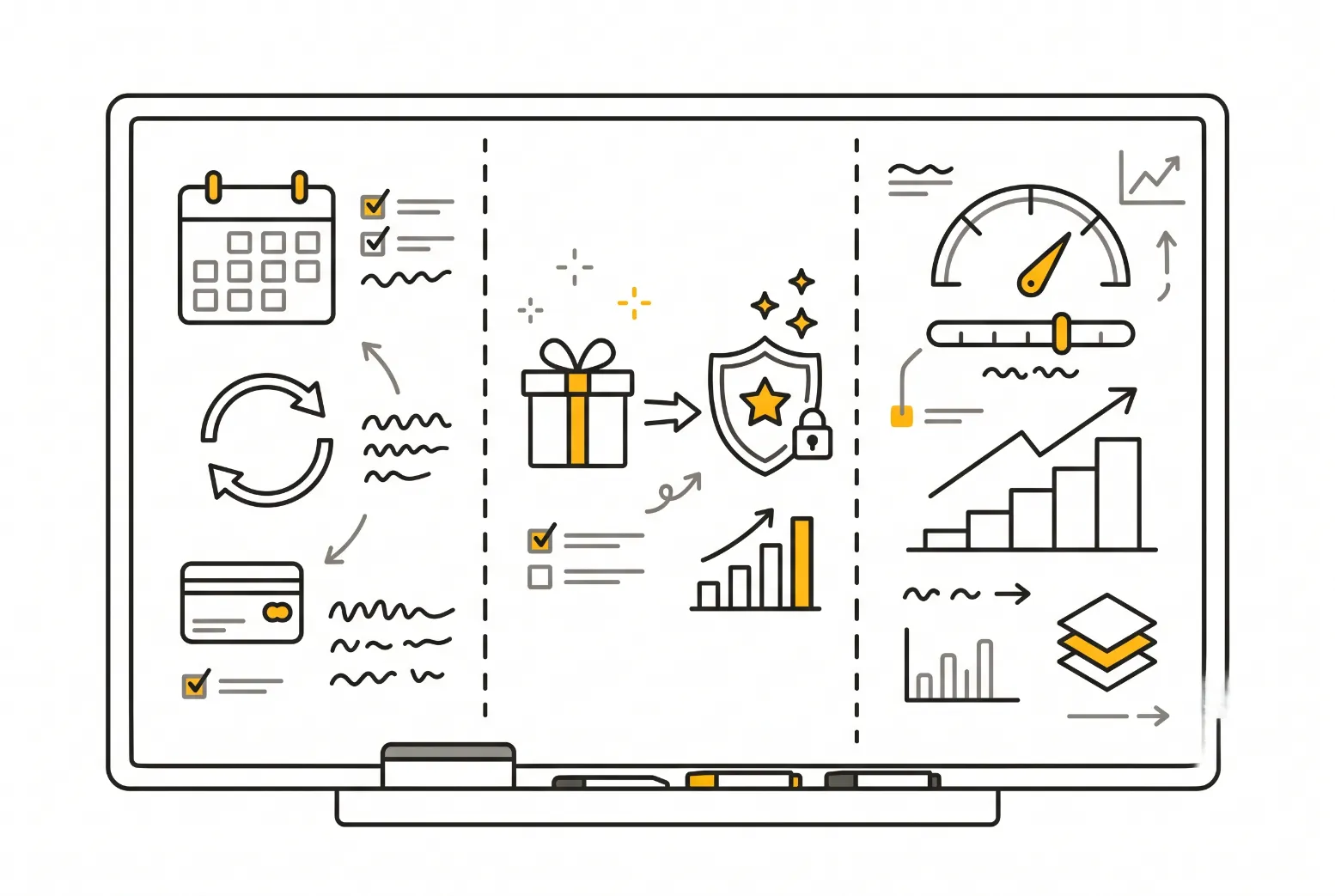
Visual idea: a simple “PX map” showing first value → core loop → edge cases → trust moments.
What is Product Experience Management
What is product experience management? It’s the discipline of intentionally shaping and measuring the experience across the whole product journey, so teams don’t optimize isolated screens while the overall journey stays frustrating.
It overlaps with UX, but it’s wider. UX focuses on usability and interaction; product experience management connects usability to outcomes like time-to-value, habit formation, and value realization. NN/g’s definition of user experience is a helpful baseline for what UX covers and where PX needs to go further.
In practice, product experience management usually means you have:
- A clear PX “north star” (what great feels like, and what it enables)
- Journey metrics (activation, adoption, retention, support deflection)
- A tight feedback loop (qual + quant → prioritization → shipping → learning)
- Cross-functional ownership (Product, Design, Eng, Data, Support)
If you want a practical way to feed real customer insights into PX decisions, this product discovery process guide is a strong companion because a better experience starts with a better understanding, not better opinions.
Digital Product Experience: Where PX is Won
Your digital product experience is often won (or lost) in the “small” moments users hit repeatedly. It’s not just the hero flow: it’s the empty states, the error recovery, the setup friction, and whether users can build trust quickly.
Four PX hotspots to improve fast:
- First value: can users reach a meaningful win in minutes, not days?
- Guidance: Do prompts, defaults, and help states reduce confusion?
- Consistency: Do patterns behave the same across journeys and devices?
- Trust: Do performance, privacy, and reliability match the promise?
A real example from delivery work: we supported a team whose product was objectively powerful, but new users churned early. The core feature wasn’t the problem; the setup path was. Once the team simplified onboarding steps, provided a “ready-to-use” default, and made the first successful action obvious, adoption improved without adding any major new features.
If you want proof of how much experience impacts adoption, the case study on driving early adoption for Lokalise’s Shopify app shows how focusing on the right experience moments can move outcomes in a very real, very measurable way.
Product experience manager: responsibilities and metrics
A product experience manager typically sits at the intersection of product, UX, and data. In some orgs, it’s a dedicated role; in others, it’s a responsibility shared across Product and Design leadership. Either way, the job is the same: ensure the product delivers value in a way users can actually reach and repeat.
What this role tends to own:
- Journey ownership: onboarding → activation → retention loops
- Experience standards: consistency, accessibility, quality bars
- Instrumentation: events, funnels, cohorts, and “success” signals
- Cross-team alignment: where experience spans multiple squads/surfaces
- Continuous improvement: turning insight into iterative releases
This role is becoming more common as product teams shift toward outcome accountability and product-led motions. Pendo’s State of Product Leadership is a useful context on how product leadership priorities are evolving, including the pressure to prove impact.
And because expectations for “good” experience keep rising, PX leaders also need to watch what technology shifts do to user baselines (speed, AI assistance, trust). Gartner’s top technology trends for 2026 are one lens for how those expectations are moving.
FAQs
Conclusion
A strong product experience isn’t a “design pass” at the end—it’s the result of clear outcomes, low friction, and trust-building moments across the entire journey. When teams treat PX as measurable and cross-functional, adoption becomes easier and retention becomes less mysterious.
If you want to improve your PX without boiling the ocean, start with the journeys that drive activation and repeat usage, then build a lightweight product experience management loop to keep improving.

Interested in working with us?
Our Interim/Fractional Product Managers, Owners, and Leaders quickly fill gaps, scale your team, or lead key initiatives during transitions. We onboard swiftly, align teams, and deliver results.
Read More Posts
October 7, 2026
Monetized Products: What It Means and How to Plan Yours
A monetized product earns revenue from the value it delivers. Learn how to build a monetization strategy for software and apps, and which model fits.
October 5, 2026
Value Proposition: What It Is and How to Write One That Sells
A value proposition tells a specific customer why your product beats their current option. Learn the meaning, canvas examples, and how to test yours.
July 17, 2026
Product Stickiness: Definition, Metrics, and How to Improve It
Product stickiness measures how often users return to your product. Learn the DAU/MAU formula, real benchmarks, and how to improve it.