
Value Proposition: What It Is and How to Write One That Sells
A value proposition tells a specific customer why your product beats their current option. Learn the meaning, canvas examples, and how to test yours.


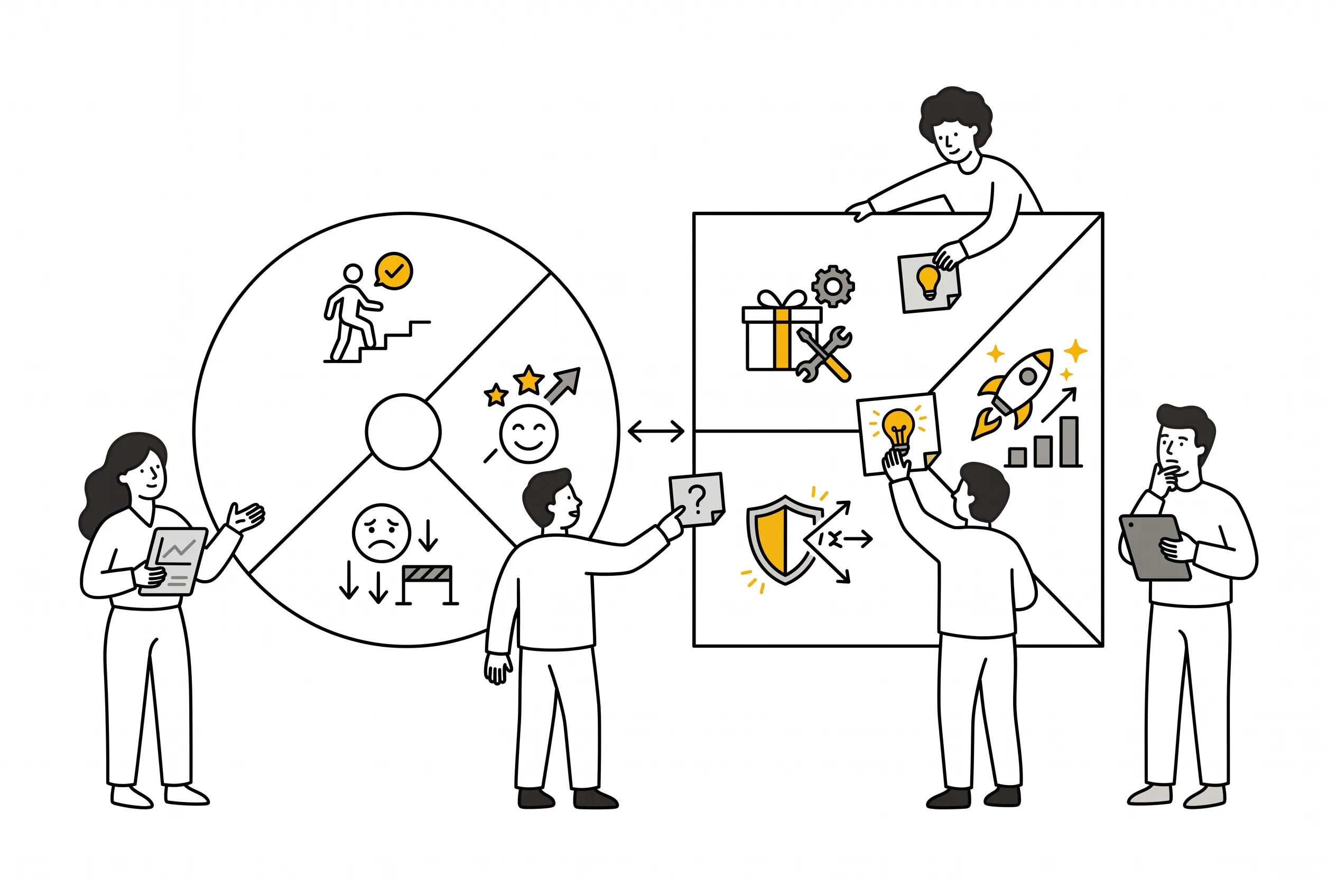
Table of Contents
A value proposition is a clear statement of the outcome a specific customer gets from your product, and why that outcome beats what they do today. It is not a slogan, a feature list, or your mission statement.
Most teams think they have one. Then you ask three people in the company to recite it and get three different answers. One quotes the website headline, one lists features, and one says "we're faster than the competition," which nobody has verified. That gap is where deals stall and roadmaps drift.
For product managers, the value proposition is a working tool, not a marketing asset. It decides which problems you solve first, which features you cut, and what you say when a sales lead asks why the customer should care. The sections below cover what the term means, how the value proposition canvas works with real examples, and how to tell whether yours belongs to the product or the market.
Value Proposition Meaning: A Promise, Not a Feature List
The value proposition meaning is simpler than most definitions make it sound. It answers one question for one customer segment: why should I pick this over what I am already doing? "What I am already doing" includes spreadsheets, a competitor, an intern, or nothing at all.
Notice what is missing from that answer. It does not describe how your product works. Product Talk makes the same point in its definition of a value proposition: the same product can carry different propositions for different segments. A gym might promise runners injury prevention and promise people trying to lose weight predictable, steady progress. Same building, same equipment, two different promises.
That is the core of a value proposition to customers. It is segment-specific, and it is written in their language, not yours. I once sat in a workshop where the team's proposition read "AI-powered workflow orchestration platform." The customer interviews we had run that week said something very different: "I just want to stop copying data between three tabs every Monday." The second sentence is the real value proposition. The first is what the team wished customers cared about.
A usable proposition has four parts:
- Who it is for, named narrowly enough that you could find ten of them this week.
- The job they are trying to get done, or the pain in the way.
- The outcome you deliver, stated as a result and not a capability.
- The alternative it beats, so the comparison is explicit.
If you cannot fill in the fourth part, you probably have a description, not a proposition. A quick test: read it aloud to a customer. If they cannot tell what changes for them, rewrite it.
One more trap is the "all benefits" proposition, where you list everything the product might do for anyone. A classic Harvard Business Review study of business markets found that most value propositions make claims of savings and benefits without backing them up, so customers dismiss them as marketing talk. The fix is not more adjectives. It is evidence: a number, a pilot result, a customer who will take the call.
Value Proposition Canvas Examples You Can Copy
The most common way to build a proposition from evidence is the value proposition canvas, created by Alexander Osterwalder and colleagues. Strategyzer describes the canvas as two halves. The customer profile captures the jobs a customer is trying to get done, the pains they hit along the way, and the gains they want. The value map describes your offering and how it relieves those pains and creates those gains.
The part teams skip is the sentence Strategyzer puts front and center: fit is a claim until customers confirm it. A completed canvas is a hypothesis. It becomes a value proposition only after real customers react to it.
Here are two short value proposition canvas examples, written as a product team would fill them in.
Example one, a B2B invoicing tool for freelancers:
- Customer job: get paid on time without chasing clients.
- Pain: awkward follow-up emails, unclear payment status, late fees nobody enforces.
- Gain: knowing exactly what cash is coming in this month.
- Value map: automatic reminders sent in the freelancer's voice, a live payment tracker.
- Resulting proposition: "Get paid on time without sending a single awkward email."
Example two, an analytics add-on for a product team:
- Customer job: show leadership which features drive retention.
- Pain: exporting data, rebuilding the same charts, arguing about definitions.
- Gain: a number everyone trusts in the Monday review.
- Value map: a shared retention dashboard with one agreed metric definition.
- Resulting proposition: "One retention number your whole leadership team agrees on."
Both resulting lines are short, but each one carries a lot of research behind it. That is the point. A good proposition is the compressed output of customer interviews, not the starting point of a brainstorm.
When you work through your own canvas, rank the pains and gains. Customers do not care about all of them equally, and a proposition that tries to relieve every pain relieves none convincingly. Pick the two or three that customers mention unprompted, and build the proposition around those. If you want a deeper walkthrough of the building steps, our guide on how to build a value proposition covers the process in more detail.
Is Value Proposition Product or Market? Both, in Order
People argue about whether a value proposition belongs to product or to marketing. The honest answer is that it starts in the market and ends in the product. The proposition describes value to a market segment, which is why it is usually listed as part of marketing strategy. But the moment you commit to it, it becomes a constraint on what the product team builds.
The order matters. Choose the segment first, then the pain, then the promise, then the features that deliver the promise. Teams that reverse this order build something, then go hunting for a segment that might want it. I have seen this go badly more than once, usually discovered when the landing page converts at a fraction of what the roadmap assumed.
Product Talk recommends developing the segment and the value proposition together, iterating until they align, and testing early with something cheap such as a landing page with different messaging. That is a good pattern because it surfaces weak propositions before engineering spends a quarter on them.
Here is a simple loop you can run in two weeks:
- Write two or three candidate propositions for one segment.
- Put each on a simple landing page or in a short outreach email.
- Compare responses, and talk to the people who replied.
- Keep the winner, rewrite the losers, and repeat once.
Once the proposition holds up, it should show up everywhere a decision gets made: feature prioritization, onboarding copy, sales decks, and success metrics. If a proposed feature does not strengthen the promise, it needs a different justification or it waits. That is how a proposition earns its place in product management, as a filter and not a poster on the wall.
Finally, review it on a schedule. Competitors move, customers change their habits, and a proposition that was sharp last year can quietly turn generic. Check it every quarter against fresh customer conversations, and update the wording when the evidence says so.
FAQ
Conclusion
A value proposition is a hypothesis about one customer segment, built from their jobs, pains, and gains, and proven only when real customers confirm it. Write it as an outcome, name the alternative it beats, and let it filter what you build.
Pick one segment this week, draft two candidate propositions, and put them in front of ten customers. If you need an experienced hand to run that process inside your team, Product People can help.

Interested in working with us?
Our Interim/Fractional Product Managers, Owners, and Leaders quickly fill gaps, scale your team, or lead key initiatives during transitions. We onboard swiftly, align teams, and deliver results.
Read More Posts
July 17, 2026
Product Stickiness: Definition, Metrics, and How to Improve It
Product stickiness measures how often users return to your product. Learn the DAU/MAU formula, real benchmarks, and how to improve it.
October 1, 2026
How to Map and Manage Stakeholders with Mendelow's Matrix
Mendelow's matrix sorts stakeholders by power and interest. Learn the four quadrants, see a worked product example, and avoid the common mapping mistakes.

July 3, 2026
Product Management Explained: Roles, Salary, and Skills
Product management defines what to build and why. Learn the role, salary ranges, interview prep, and books every product manager should know.