

How to Map and Manage Stakeholders with Mendelow's Matrix
Mendelow's matrix sorts stakeholders by power and interest. Learn the four quadrants, see a worked product example, and avoid the common mapping mistakes.


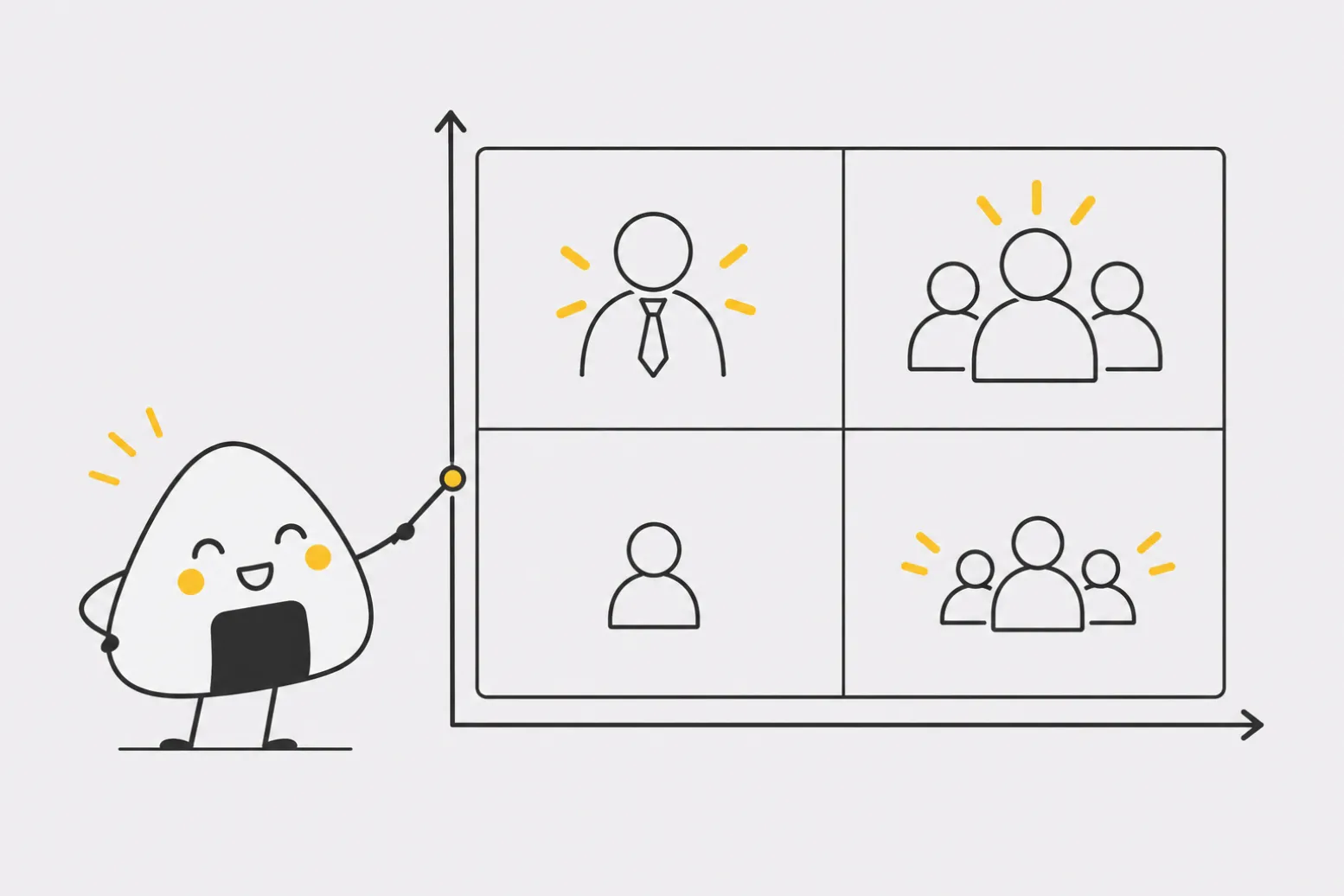
Table of Contents
Audio
Mendelow's matrix is a two-by-two grid that sorts stakeholders by how much power they hold and how much they care about your project. The result is four groups, each with its own engagement approach: manage closely, keep satisfied, keep informed, and monitor.
Aubrey Mendelow introduced the idea in 1991, and it has outlived plenty of shinier frameworks because it is cheap to run. You need a whiteboard, a stakeholder list, and about 45 minutes of honest conversation.
That last part is where most teams stumble. The grid itself is trivial. Deciding that the VP of Sales has more power over your launch than the lead engineer is not, and neither is saying so out loud. This article covers how the matrix works, a worked product example, and the mistakes that turn a useful map into a decorative slide.
What Mendelow's Matrix Actually Tells You
The matrix plots every stakeholder on two axes. Power is their ability to influence what happens: approve budget, block a release, change priorities. Interest is how much they care about the outcome of this specific initiative, not about the company in general.
Crossing the two axes gives four quadrants:
- High power, high interest (manage closely): These people can make or break the work and they are paying attention. Involve them in decisions, not just updates.
- High power, low interest (keep satisfied): They can veto you but are not following the details. Give them short, well-timed briefings so nothing surprises them.
- Low power, high interest (keep informed): Users, support teams, and adjacent squads care a lot but cannot decide. They are a great source of feedback and early warning.
- Low power, low interest (monitor): Watch for changes, but do not spend meeting time here.
The research base is worth knowing. The idea comes from work on environmental scanning, and the Open University's course material on IT systems still teaches the power versus interest grid as a starting point for deciding how much effort each group deserves. The framework's value is that it forces you to spend limited attention on purpose instead of by whoever emails loudest.
One caution from experience: the quadrants are a starting hypothesis. A stakeholder in "monitor" who turns out to have a friend on the executive team is not in "monitor" anymore. Treat the grid as a living document, not a filing cabinet.
A Worked Example for Mendelow Stakeholder Mapping
Say your team is replacing the checkout flow in a B2B SaaS product. Here is how a Mendelow stakeholder example might look for that project.
The CFO sits in high power, high interest because checkout touches revenue recognition and she has already asked twice about timelines. She goes in "manage closely": a fortnightly working session, not a slide deck. The Head of Legal has high power and low interest until the new flow changes payment terms, at which point interest spikes. Put them in "keep satisfied" and agree in advance on the trigger that moves them.
Customer support has low formal power but very high interest, because every checkout bug becomes their ticket queue. They go in "keep informed", with a shared channel and early access to staging. In practice they will also tell you what is broken before your analytics do. The marketing intern who once asked about the roadmap lands in "monitor".
Now watch what the grid gives you. Without it, the team would probably have spent Thursday's meeting on the support team's feature requests, because they are vocal and friendly, while the CFO learned about a two-week slip from a Slack rumor. With it, the priorities are visible on one page.
A few tips for running the session:
- List stakeholders by role first, then attach names. It keeps the conversation off personalities.
- Score power and interest separately, in silence, before discussing. Otherwise the loudest voice sets the score.
- Write down the next action for each person, not just their quadrant.
- Revisit the map at every major milestone. If you want a sense of how this feeds decisions about what to build first, our piece on roadmap planning and prioritization frameworks shows where stakeholder input fits.
The payoff is real. PMI's 2026 Pulse of the Profession found that 50% of high-performing teams use phased stakeholder engagement, against 42% of low performers. Phased simply means you keep reassessing who needs to be involved, which is exactly what a refreshed matrix does.
Where the Matrix Falls Short (and What to Add)
Mendelow's matrix is honest about being simple, and that is also its limit. It has no view of whether a stakeholder's claim is legitimate or how time-sensitive it is. A regulator with a hard deadline and a senior manager who dislikes your approach can both land in "high power". They are not equally urgent.
Mitchell, Agle, and Wood addressed this gap in their 1997 paper, Toward a Theory of Stakeholder Identification and Salience. Their model scores stakeholders on power, legitimacy, and urgency, and it treats those attributes as changeable over time. For a product team, that means you can use Mendelow's grid to get everyone on the page quickly, then apply the salience lens to your "manage closely" group when you have to choose between competing demands.
The other common failure is mapping once and never returning. Interest changes fast. A stakeholder who ignored your project in January may care intensely in March because their own OKRs now depend on it. Power changes too, after reorganizations, budget cycles, and the odd resignation.
A few habits keep the matrix honest:
- Map per initiative, not per company. Someone can be high interest on one project and invisible on the next.
- Include people who are quietly opposed. Resistance is information, and a hidden blocker is worse than a loud one.
- Keep the map private. Circulating a document that labels a director "low interest" is a creative way to lose an ally.
- Pair the map with a communication plan, or it stays a diagram.
If your team is stretched and stakeholder alignment keeps slipping, that is often a capacity problem rather than a framework problem. An experienced product management consultant can run the mapping session, take the difficult conversations, and hand the process back once it works.
FAQ
Conclusion
Mendelow's matrix earns its place because it turns a vague sense of "we should talk to more people" into a ranked plan. Sort by power and interest, act differently on each quadrant, and keep the map current as the project moves.
Your next step is small: block 45 minutes this week, list the stakeholders for your current initiative, and score them silently before you discuss. You will likely find one person in the wrong box, and that alone is worth the session.

Interested in working with us?
Our Interim/Fractional Product Managers, Owners, and Leaders quickly fill gaps, scale your team, or lead key initiatives during transitions. We onboard swiftly, align teams, and deliver results.
Read More Posts
July 3, 2026
Product Management Explained: Roles, Salary, and Skills
Product management defines what to build and why. Learn the role, salary ranges, interview prep, and books every product manager should know.

August 21, 2026
What Is Immersion? A Product Manager's Guide to AI Interfaces
Immersion in UX explained: what it means, how AI-powered interfaces create it, and how product teams should design for it without overreach.

September 28, 2026
PRD Meaning: What a Product Requirements Document Really Is
PRD meaning explained: what a product requirements document covers, who writes it, and how to build a PRD template your team will actually use.