
What Is Value Proposition and How to Build One
A value proposition tells customers what they get and why it beats the alternative. Here's how product teams define, test, and sharpen theirs.


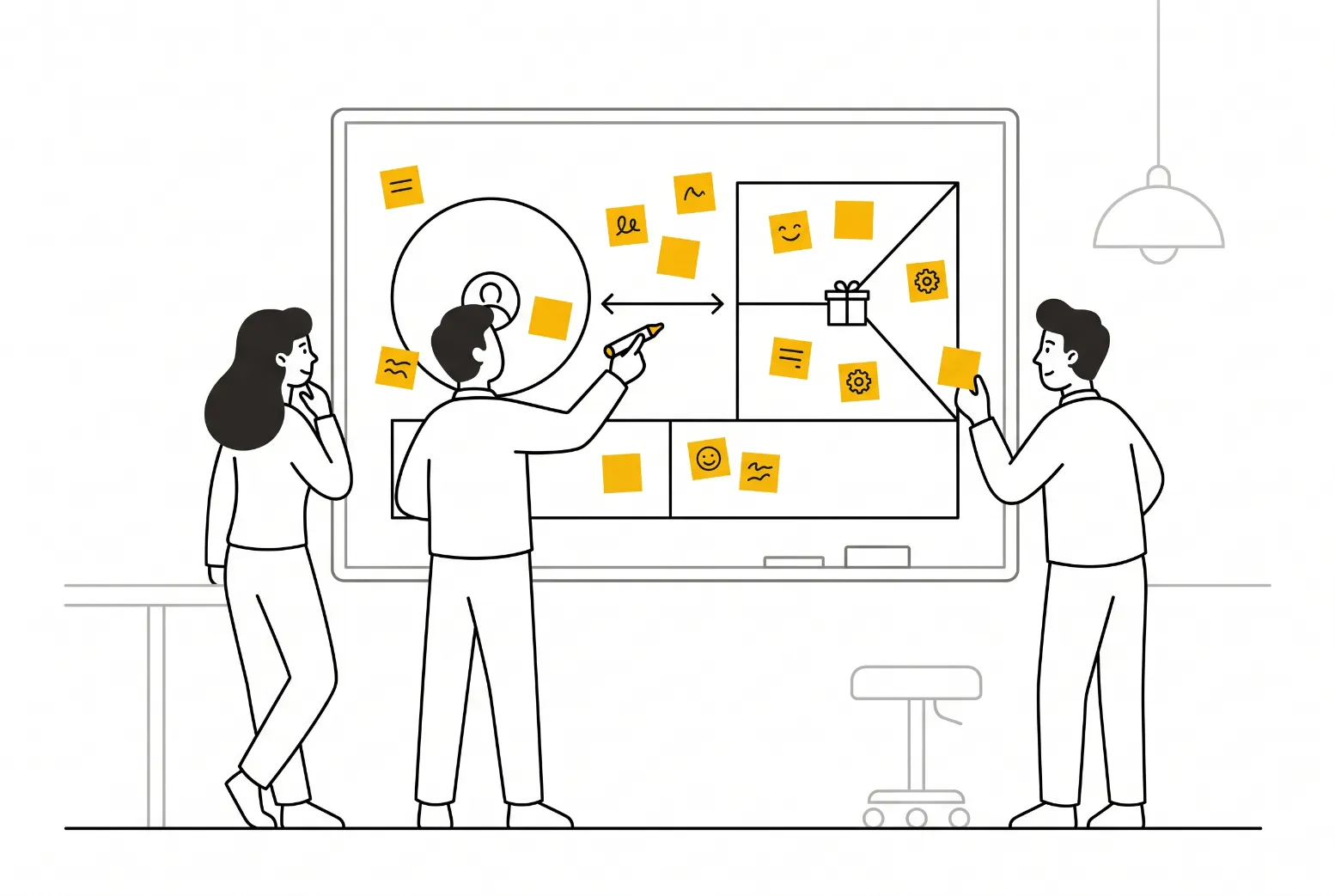
Table of Contents
Audio
A value proposition is the specific outcome a customer gets from your product, stated clearly enough that they can weigh it against what they already do today, including doing nothing. It is not a slogan and it is not your feature list. It is the answer to the question every buyer is quietly asking before they open their wallet: why this, why now, why you.
Most product teams learn this the hard way. I have sat in launch reviews where the deck had four bullet points of "key differentiators" and not one sentence a customer could repeat back afterward. A feature list is not a value proposition. A value proposition is the sentence that survives once you strip out everything engineering is proud of and keep only what the customer actually notices.
Getting this right shapes everything downstream, from an early go-to-market strategy to how you defend pricing two years later. Get the value proposition wrong and every decision that depends on it, messaging, sales scripts, even onboarding, inherits the same confusion.
What Is a Value Proposition (And What It Isn't)
A value proposition names the job the customer is trying to get done, the specific way your product does it, and why that beats the alternative they are using now. It is not your mission statement, which is about why your company exists, and it is not a tagline, which is a marketing wrapper around the value proposition rather than the thing itself. Teams mix these up constantly, and the result is a homepage headline that sounds inspiring but tells a buyer nothing they can act on.
The confusion used to be survivable because a salesperson could clarify it in a call. That safety net is mostly gone. A recent Gartner survey found that 61% of B2B buyers now prefer a rep-free buying experience, which means your product page, your trial flow, and your pricing table have to do the explaining a rep used to do live. If the value proposition only lives in a founder's head or a sales deck, most of your prospects never hear it at all.
A useful test: read your current value proposition out loud to someone outside your company. If they respond with a question about what the product actually does, you have written a tagline, not a value proposition. If they respond by asking what it costs, you are closer, because that means they already understood the value and are now pricing it against the alternative.
I once watched a founder try to settle an internal argument by asking three department heads to each write down the company's value proposition in five minutes. Marketing wrote a tagline about "empowering teams." Sales wrote a list of integrations. Product wrote a sentence about reducing manual reporting by a specific number of hours a week. Only one of those three was actually a value proposition, and it was the one with a measurable outcome in it, not the one that sounded the most polished.
Testing It With the Value Proposition Canvas
Writing a value proposition from a whiteboard guess is how you end up defending assumptions nobody validated. The value proposition canvas, developed by Alex Osterwalder's team and published as an open framework by Strategyzer, forces you to separate what you think the customer needs from what you are actually building for them.
The canvas splits into two halves that have to match:
- Customer side
- Jobs the customer is trying to do
- Pains they hit along the way
- Gains they hope for
- Product side
- Products and services you offer
- How you relieve those pains
- How you create those gains
I ran this exercise with a support team once after a customer canceled and left a review calling our onboarding "a full-time job." We had assumed the customer's job was "set up the integration." Her actual job was "prove to her boss this tool was worth the budget line by Friday." Once we rewrote the canvas around that job, the entire onboarding sequence changed, and so did the value proposition on the pricing page.
Value proposition development is not a one-time workshop. Revisit the canvas whenever you ship a feature that changes what the product actually relieves or creates, because a canvas built before a major release is describing a product that no longer exists.
The exercise also exposes lazy assumptions faster than a roadmap meeting does. It is easy to write "saves time" on a sticky note and move on. It is much harder to write down the actual pain, in the customer's own words, and defend why your product relieves that specific pain better than the spreadsheet or competitor tool sitting next to it. If a pain reliever on your canvas does not map to a real, named pain on the customer side, cut it before it makes its way into the statement.
Turning It Into a Product Value Proposition Statement
Once the canvas holds up, compress it into a statement a customer could repeat back after reading it once. A format that works for most product value proposition statements: for [target customer] who [job or pain], [product] is the [category] that [outcome], unlike [current alternative], because [reason to believe].
Keep it to one to three sentences. If it takes a paragraph to explain, the value is not clear yet, it is just longer. A rough example, stripped of any real brand: for operations managers who lose a day a month reconciling spreadsheets, this tool is the reporting layer that closes the books in an afternoon, unlike the manual export-and-merge process most teams still run, because it pulls directly from the source systems instead of a static export.
Consistency matters as much as the wording. McKinsey's research on B2B growth found that buyers now use roughly ten channels across a purchase, up from five in 2016, and companies that keep their value proposition consistent across all of them are the ones pulling ahead. A value proposition that reads differently on the website, the sales deck, and the app store listing is not three value propositions. It is one weak one, diluted three times.
This is also where a value proposition earns its keep on the pricing strategy conversation. You cannot defend a price increase with a feature list. You can defend it with a value proposition that names the outcome the customer is paying for and shows the price moved because the outcome got bigger, not because the product got more complicated.
Frequently Asked Questions
Conclusion
A value proposition is not a marketing exercise you finish once and file away. It is the sentence your product has to keep earning, through every release, every pricing change, and every channel a customer might meet you in first.
Start by writing down what you think your value proposition is right now, then hand it to someone who has never seen your product and ask them to explain it back. Whatever gets lost in that translation is the work still ahead of you.

Interested in working with us?
Our Interim/Fractional Product Managers, Owners, and Leaders quickly fill gaps, scale your team, or lead key initiatives during transitions. We onboard swiftly, align teams, and deliver results.
Read More Posts
October 15, 2026
Lean Canvas: What It Is and How to Fill It Out Step by Step
A lean canvas is a one-page plan that turns your startup idea into testable assumptions. See the template, the nine boxes, and how to fill it out.

October 12, 2026
Semantic Differential Scale: How to Measure Perceptions Right
Learn how a semantic differential scale works, when to pick it over a Likert scale, and how to build one that shows how users really perceive your product.
October 9, 2026
Let the numbers do the talking
Senior leaders talk numbers. How to justify roadmap decisions with business impact, and which guardrails tell you when to skip the analysis.