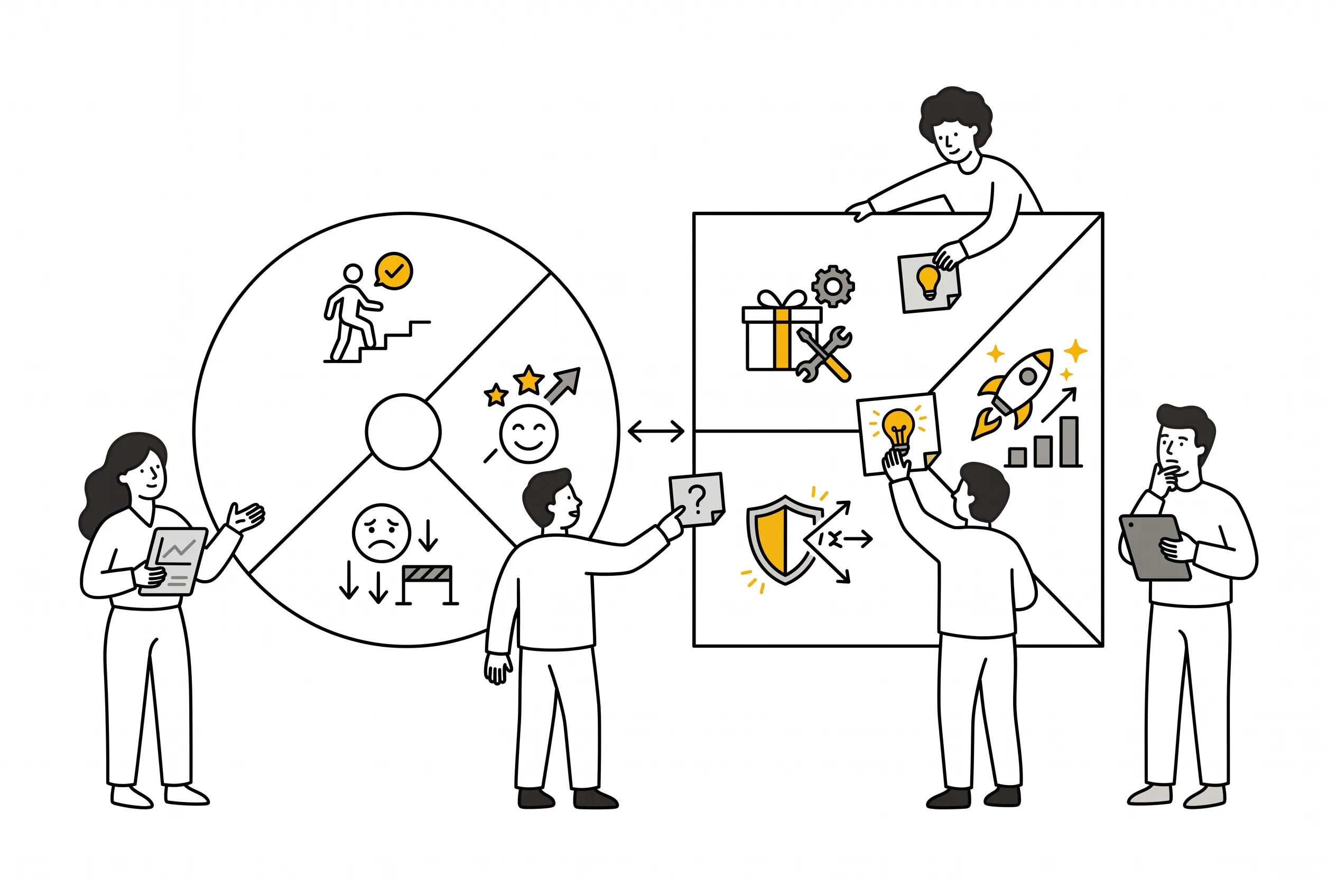

Monetized Products: What It Means and How to Plan Yours
A monetized product earns revenue from the value it delivers. Learn how to build a monetization strategy for software and apps, and which model fits.


Table of Contents
Monetized Products: What It Means and How to Plan Yours
A monetized product is one that earns revenue from the value it gives users, through a defined model such as subscriptions, usage fees, ads, or one-time purchases. Monetized does not mean "has a price tag." It means someone decided who pays, for what, and when.
Plenty of products skip that decision. The team ships, users arrive, and a pricing page gets bolted on three months later by whoever has a free afternoon. The result is a revenue model that fights the product. Engineers build features nobody will pay for, sales promises things the packaging cannot deliver, and finance asks why growth in users never shows up in the bank account.
For product managers, monetization is a design problem, not an accounting one. It shapes onboarding, the roadmap, and what you measure. The sections below cover what a solid monetization strategy contains, how software and apps differ in the models they favor, and where teams most often go wrong.
Building a Monetization Strategy Around Customer Value
A monetization strategy answers four questions: what you charge for, who pays, how much, and when. Price is only the third of those. A team that argues about whether to charge $29 or $39 before agreeing on what the unit of value is has started in the wrong place.
Start with the value metric, the thing customers experience as getting more or less of. For a project management tool it might be seats. For an API it is calls. For a data product it might be reports generated. When the metric matches how customers perceive value, price rises feel fair. When it does not, every renewal becomes a negotiation. Picture a customer success manager explaining why a customer with three heavy users pays less than a customer with fifty who log in once a quarter. That conversation is a monetization design flaw, not a sales problem.
The evidence suggests most companies have not solved this. Revenera surveyed 501 senior executives at technology companies for its Monetization Monitor 2026 outlook, and only 36% reported strong alignment between their pricing and the value customers receive. Roughly two thirds of the industry, in other words, is charging for something other than what customers think they are buying.
A workable process looks like this:
- Interview customers about the outcome they pay for, not the features they use.
- Segment by willingness to pay, since a freelancer and an enterprise team rarely value the same thing.
- Pick one value metric and test it against your three largest accounts.
- Set packaging tiers around outcomes, then price them.
- Review the model every two quarters, because customers and costs both move.
If you need a deeper walkthrough of the pricing side, our guide to pricing strategy covers the frameworks in more detail. The point here is sequence: value first, metric second, price last. Teams that reverse the order usually end up discounting their way out of a model that was never grounded in what customers wanted.
Software Monetization Strategy: Subscription, Usage, or Hybrid
A software monetization strategy has historically meant one thing: subscriptions. That is changing. In the same Revenera report, 56% of respondents expect usage-based revenue to grow by 2027, and consumption models now rank second behind subscriptions in prevalence. Hybrid models, a base subscription plus metered usage, are gaining the most ground.
The driver is AI. Revenera found that 80% of respondents already offer AI-enabled features, yet 70% say delivery costs are undermining profitability. Anyone who has watched a flat-rate plan get consumed by a handful of heavy users understands why. A customer who sends ten thousand model queries a day costs you far more than one who sends ten, and a flat fee hides that gap until the invoice from your cloud provider arrives. Pure subscription strategies for AI products are projected to fall by 5% over the next 18 months, while blended models grow by the same amount.
Here is how the main options compare:
- Subscription works best when usage is steady and value is continuous. The main risk is churn when perceived value drops.
- Usage-based works best when cost and value scale with consumption. The main risk is that unpredictable bills slow procurement.
- Hybrid works best when costs vary but buyers want a budget line. The main risk is that it is more complex to explain and to bill.
- Per-seat works best when value grows with team adoption. The main risk is that customers cap seats to save money.
Neither choice is free. Usage-based pricing lowers the barrier to starting, but finance teams at your customers will ask for forecasts and caps before they sign. Subscriptions give you predictable revenue but force you to guess a price before usage data exists. Hybrid models split the difference and add billing complexity, so make sure your engineering team has capacity to maintain metering before you commit.
A practical test: if your marginal cost per customer varies by more than a factor of five, a flat subscription is probably subsidizing your heaviest users. That is the signal to add a usage component.
App Monetization Strategy: Freemium, Paywall, or Ads
An app monetization strategy faces a different constraint. Users arrive through an app store, decide within minutes whether to stay, and the platform takes a cut of what they pay. Apple, for one, keeps 30% of subscription revenue in a subscriber's first year and 15% after that, which belongs in your margin math from day one. The App Store subscription terms also let you offer free trials, pay-as-you-go introductory pricing, and win-back offers, so the platform gives you more levers than most teams use.
The most useful data point comes from RevenueCat's State of Subscription Apps 2026, which analyzed more than 115,000 apps. Hard paywall apps showed a median Day-35 trial-to-paid conversion of 10.7%, against 2.1% for freemium apps. By Day 60, hard paywall apps earned $3.09 in revenue per install, compared with $0.38 for freemium. Twelve-month retention was nearly identical, at 27% and 28%.
Read that carefully. It does not say freemium is wrong. It says freemium converts slowly and earns less per install early on, which matters if you are paying for each install through ads. Free tiers still make sense when the product spreads through sharing, when network effects matter, or when you need usage data to improve the product. They fail when the free version is already enough, which is a common outcome.
A short decision guide:
- If your acquisition is paid, a hard paywall or a short trial protects your unit economics.
- If your acquisition is organic or viral, freemium can compound in your favor.
- If your audience is large but pays little, advertising may fit, though it rarely suits products where trust is the selling point.
Whichever you pick, treat the first model as a hypothesis. Run it for a quarter, look at conversion by cohort, and be willing to change it. Monetization that never gets revisited tends to drift out of line with the product it was designed for.
FAQ
Conclusion
Subscription works best when usage is steady and value is continuous. The main risk is churn when perceived value drops.
Usage-based works best when cost and value scale with consumption. The main risk is that unpredictable bills slow procurement.
Hybrid works best when costs vary but buyers want a budget line. The main risk is that it is more complex to explain and to bill.
Per-seat works best when value grows with team adoption. The main risk is that customers cap seats to save money.

Interested in working with us?
Our Interim/Fractional Product Managers, Owners, and Leaders quickly fill gaps, scale your team, or lead key initiatives during transitions. We onboard swiftly, align teams, and deliver results.
Read More Posts
October 5, 2026
Value Proposition: What It Is and How to Write One That Sells
A value proposition tells a specific customer why your product beats their current option. Learn the meaning, canvas examples, and how to test yours.
July 17, 2026
Product Stickiness: Definition, Metrics, and How to Improve It
Product stickiness measures how often users return to your product. Learn the DAU/MAU formula, real benchmarks, and how to improve it.
October 1, 2026
How to Map and Manage Stakeholders with Mendelow's Matrix
Mendelow's matrix sorts stakeholders by power and interest. Learn the four quadrants, see a worked product example, and avoid the common mapping mistakes.