

Go-to-Market Strategy: Framework, Steps, and Examples
What is a go-to-market strategy? Learn the framework, the building blocks, and a real example before your next launch.


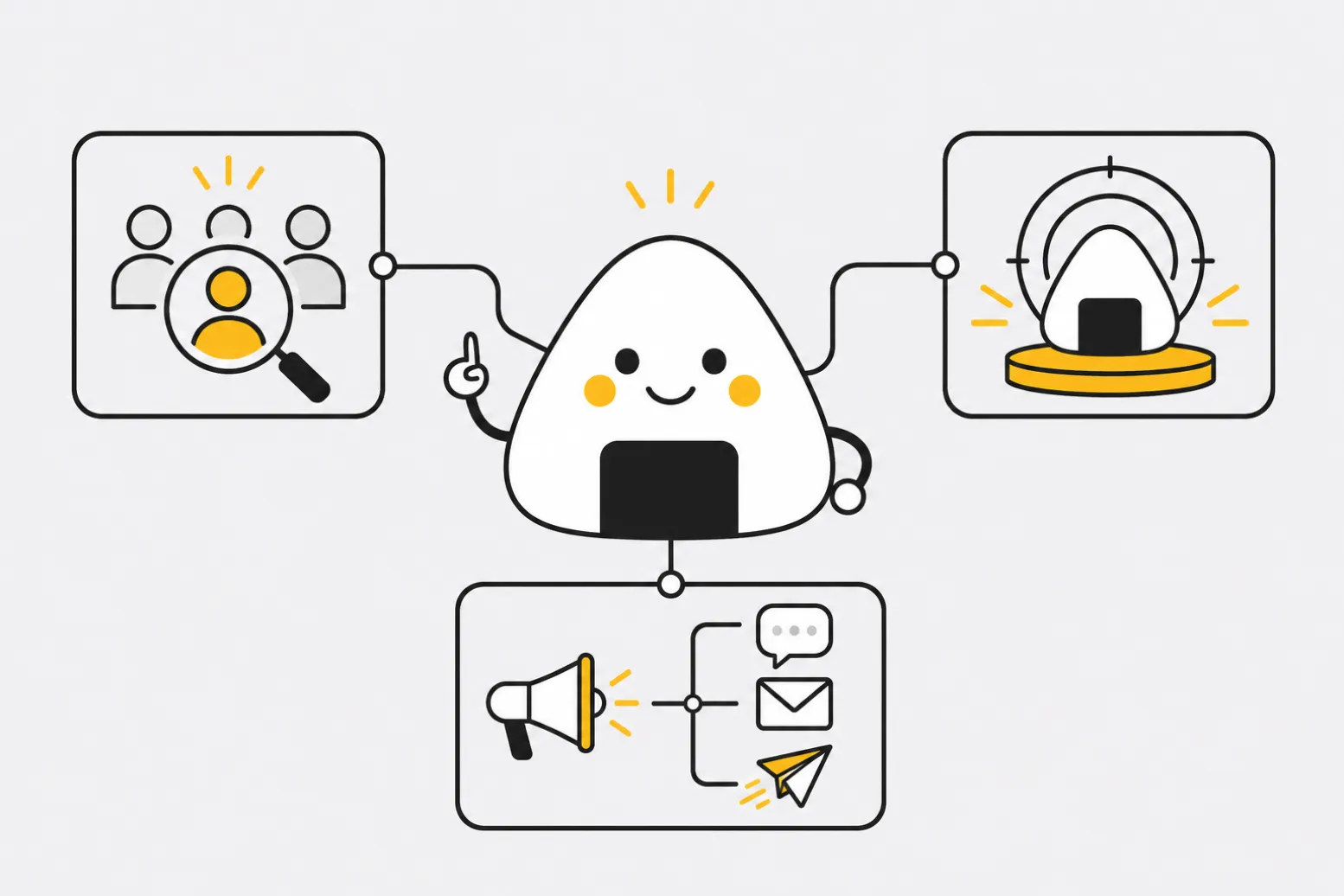
Table of Contents
A go-to-market strategy is the plan a company uses to bring a product to the right customers, priced, positioned, and channeled to sell from day one. It connects your target market, your value proposition, your pricing, and the channels you will use to reach buyers, so every team works from the same playbook instead of improvising after launch.
Without one, launches turn into guesswork. Sales does not know who to call first, marketing does not know what message to lead with, and product cannot tell which features actually move a prospect to buy. A clear go-to-market strategy forces those decisions before launch day, not during it, which is why it has become a standard deliverable for any serious product or marketing team.
This article covers what "go to market" actually means, the framework product and marketing teams use to build a plan, and a real go-to-market strategy example you can study before writing your own. You will also find quick answers to the questions teams ask most often before their first launch.
What Does Go to Market Mean?
"Go to market" describes the coordinated act of introducing a product or service to buyers and generating the first wave of revenue around it. The phrase gets used as a verb ("we go to market in Q3") and as a noun (the strategy document itself), which is part of why people confuse it with marketing more broadly.
A go-to-market strategy is not the same as a marketing strategy, even though the two overlap. A marketing strategy is a long-term plan for building brand awareness and customer loyalty across the life of a company. A go-to-market strategy is narrower and time-bound: it applies to one product, one launch, or one market entry, and it wraps up once that launch has stabilized.
- Scope: GTM covers a single product or launch; marketing strategy covers the whole brand.
- Timeline: GTM is short-term and tied to a launch date; marketing strategy runs continuously.
- Owners: GTM usually pulls product, sales, and marketing into one plan; marketing strategy sits primarily with the marketing team.
GTM moments are not limited to brand-new products, either. A company needs a go-to-market strategy any time it launches a new product, enters a new market, or repositions an existing product for a different buyer. According to Gartner's 2023 State of Go-to-Market Strategies survey, 85 percent of respondents said their go-to-market strategy was effective at driving revenue, and 62 percent described their approach as primarily product-led, a sign of how far GTM thinking has moved beyond a traditional sales-led launch.
Go-to-Market Strategy Framework: Building Blocks
Most go-to-market strategy frameworks boil down to the same six building blocks, regardless of company size or industry.
- Target market and buyer. Define exactly who you are selling to, their role, company size, and the specific problem they have that your product solves.
- Value proposition. State the outcome the customer gets and why your product delivers it better than the alternative they use today, including doing nothing.
- Pricing and packaging. Decide the price, the pricing model (subscription, usage-based, one-time), and how many tiers you will offer at launch.
- Distribution channels. Choose how customers will actually buy: self-serve signup, inside sales, field sales, partners, or a marketplace.
- Marketing go to market plan. Map the specific campaigns, content, and channels marketing will run to create demand and hand qualified leads to sales.
- Metrics and feedback loop. Set the numbers that tell you the launch is working, such as activation rate, sales cycle length, or new pipeline, and review them on a fixed cadence.
McKinsey's research on enterprise tech go-to-market found that more than 30 percent of B2B buyers now use digital, self-serve channels at every stage of the purchase journey, not just for research. That shifts channel choice, building block four, from an assumption into something worth testing directly with your specific buyer before you commit budget to it.
That marketing plan increasingly leans on AI-assisted content and personalization. HubSpot's 2026 State of Marketing Report found 61 percent of marketers now consider AI the biggest disruption to their field in two decades, which is reshaping how quickly a go-to-market plan's messaging and content can be produced and tested.
None of these six blocks work in isolation. A pricing model built for self-serve buyers falls apart if your distribution channel is a six-month enterprise sales cycle, and a value proposition aimed at a VP will not land if your content only reaches individual contributors. Teams that treat the go-to-market plan as a single connected system, rather than six separate documents, catch these mismatches before launch instead of after it.
Go-to-Market Strategy Example in Practice
A useful go-to-market strategy example shows how the framework plays out when a product actually launches, not just how it looks on a slide.
Take a mid-size SaaS company adding a new analytics module to its existing platform. Its target buyer is already a customer, so the target market step is fast: existing accounts above a certain usage threshold. The value proposition is narrow and specific: turn raw usage data the customer already generates into a weekly report their manager will actually read. Pricing is a flat add-on fee rather than a new subscription tier, because it reduces the number of new decisions a buyer has to make.
For distribution, the company skips a new sales motion entirely and routes the offer through its existing customer success team and in-app notifications, since the buyers are already inside the product. The marketing plan is limited to a short email sequence and a single case study, because the audience is warm, not cold. Success is measured by one metric: the percentage of eligible accounts that activate the module within 30 days.
This mirrors what companies choosing a product-led growth motion do by design: they let the product's existing usage data do the selling, instead of building a new outbound sales process for every feature. The lesson generalizes past SaaS. A go-to-market strategy example that skips steps because "this launch is simple" is usually the one that overspends on channels the buyer never uses. Working through all six building blocks, even briefly, keeps the plan proportional to the actual launch.
FAQ
Conclusion
A go-to-market strategy turns a launch from a leap of faith into a plan you can test, measure, and repeat. Get the target buyer, value proposition, pricing, channel, marketing plan, and metrics right, and even an ambitious launch becomes a series of manageable decisions instead of a guess.
Before your next launch, walk through the six building blocks above with your product, marketing, and sales leads in the same room. If two of them disagree on the target buyer or the pricing model, that is the gap to close before you set a launch date, not after.

Interested in working with us?
Our Interim/Fractional Product Managers, Owners, and Leaders quickly fill gaps, scale your team, or lead key initiatives during transitions. We onboard swiftly, align teams, and deliver results.
Read More Posts
September 11, 2026
Quantitative Investigation: How to Measure Digital CX
Learn how quantitative investigation turns website and app data into a real digital customer experience strategy, with metrics that matter.

September 10, 2026
Power is Not Always Formal
Product People founder Mirela Mus on getting things done without formal authority, and what she looks for in a leader who can do the same.

September 9, 2026
How to Collect and Actually Use Customer Feedback
Customer feedback only helps if you collect it well and act on it. Real examples, collection methods, and how to close the loop.