
Product Development: Process, Lifecycle & Best Practices
Learn what product development is, how the process works, and how agile and MVP approaches help modern teams build better products.


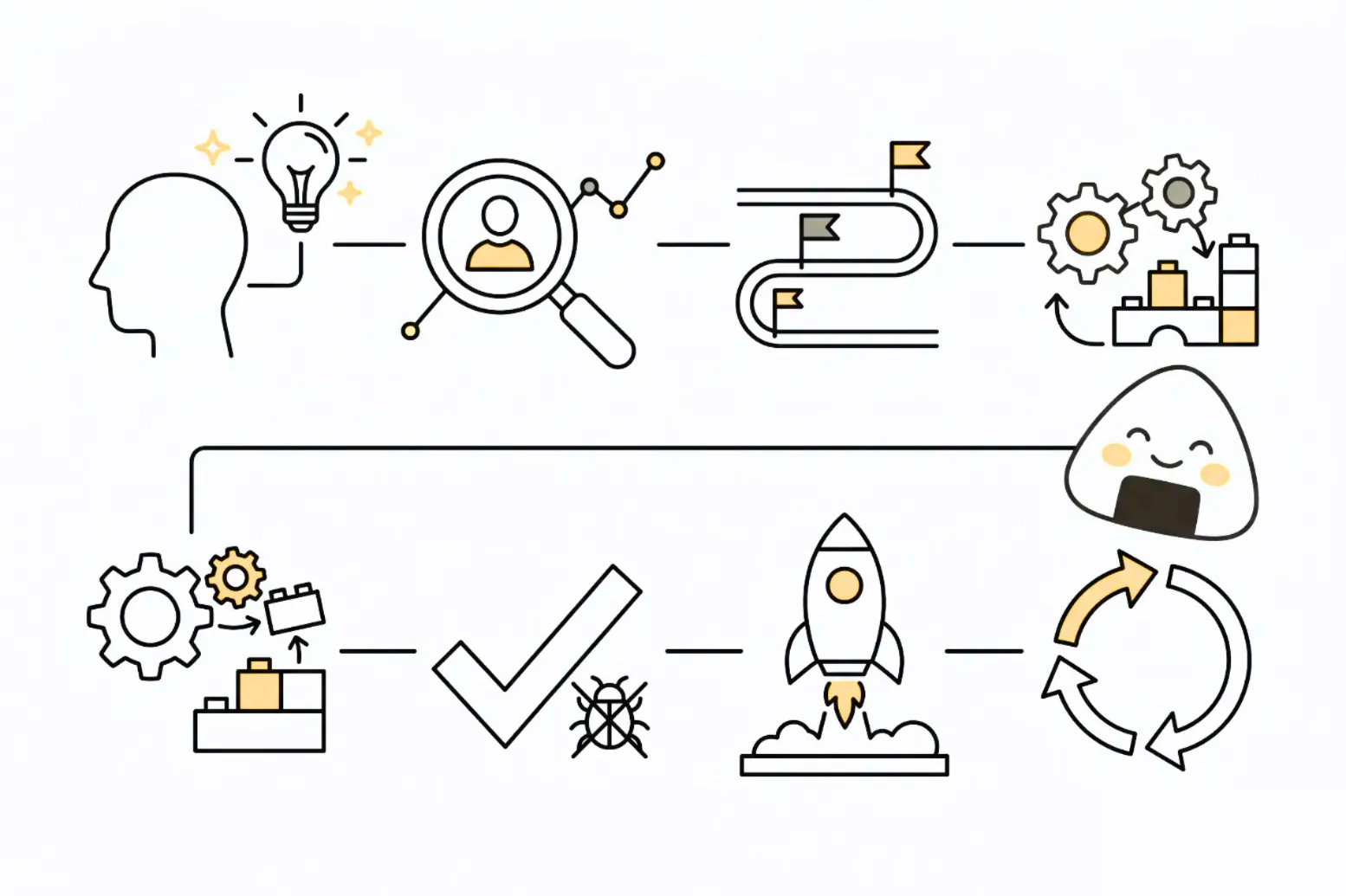
Table of Contents
Audio
Product development is the end-to-end process of taking a new product from initial concept to market launch and beyond. It covers every activity involved in creating, validating, designing, building, and releasing something new, whether that is a software platform, a physical device, or a significant update to an existing product.
The stakes are real. Research from MIT Professional Education estimates that approximately 95% of new products fail to meet their initial targets. Most of those failures are not execution problems. They are process problems: assumptions left unvalidated, discovery work skipped, and teams starting to build before they have established what they are actually building toward.
This article walks through the product development process step by step, explains what the product development lifecycle involves in practice, and covers how agile and MVP product development have changed how modern teams reduce risk and ship products that stick.
The Product Development Process, Step by Step
The product development process is the structured sequence of activities that converts a raw idea into a working, tested, launched product. No universal framework exists, but the underlying logic is consistent across industries and company sizes.
Ideation is the starting point. Teams generate potential solutions by analyzing customer interviews, support data, market trends, and competitor behavior. The goal is not to produce the perfect idea but to surface enough validated possibilities to identify which are worth exploring further.
Discovery and definition converts a promising concept into a clear brief. This involves aligning stakeholders on scope, documenting user needs, establishing measurable success criteria, and drafting an early roadmap. Skipping this step is one of the most reliable ways to end up building the wrong thing with full engineering precision.
Prototyping happens before production-level work begins. Early prototypes can be paper sketches, low-fidelity wireframes, or interactive mockups. Their purpose is to test assumptions cheaply, before significant engineering resources are committed. A problem surfaced at prototype stage costs a fraction of what the same problem costs when it surfaces during QA.
Design and development is where the product takes final form. UX designers finalize the experience while engineers implement it. Tight, ongoing collaboration between these two functions at this stage prevents the rework that tends to follow a sequential hand-off model.
Testing covers both internal quality assurance and external user validation. Teams check for bugs and edge cases, but also confirm that the product solves the original problem in the way actual users expect. Beta programs, usability sessions, and A/B testing all belong in this phase.
Launch and iteration closes the cycle while starting the next one. Post-launch monitoring, feedback loops, and rapid iteration determine how a product matures. The teams that compound their learning across successive releases are the ones that treat a launch as the beginning of a learning loop, not the end of the project.
For more on how a product's arc continues after it goes live, Product Life Cycle: Stages, Strategy, and Management covers the full commercial trajectory from introduction through decline.
The Product Development Lifecycle, Explained
The product development lifecycle refers to the complete arc a product moves through from first concept to live release. This is frequently confused with the product life cycle, which tracks a product's commercial performance after it is already on the market. The development lifecycle focuses specifically on what happens before and during the build.
That distinction matters practically because the two cycles require different team structures, decisions, and performance metrics. IBM's overview of product development describes it as a cross-functional discipline spanning engineering, design, marketing, and operations, with each function playing an active role across multiple stages rather than just its own.
Each phase produces a distinct output:
- Ideation: a prioritized list of validated opportunities
- Discovery: a defined brief and initial roadmap
- Prototyping: tested concepts with key assumptions cleared
- Design and development: a working, testable build
- Testing: a QA-cleared, user-validated release candidate
- Launch: live product data and a first feedback baseline
In practice, the lifecycle is rarely linear. Teams using iterative methodologies revisit and refine earlier decisions throughout the build. This is not dysfunction; it is the natural result of learning more about users and constraints as the project progresses. Frameworks that accommodate this reality produce better outcomes than those that treat development as a fixed waterfall with no room for course correction.
The most persistent mistake teams make is treating the development lifecycle as ending at launch. In modern product practice, the post-launch phase is where the highest-quality learning data arrives, and the teams that act on it consistently are the ones that build compounding product quality over time.
Agile and MVP Product Development Explained
Agile product development and MVP product development share the same origin insight: traditional waterfall development, which locked requirements in at the start and delivered a finished product at the end with no feedback loop, produced too many products that missed what users actually needed by the time they shipped.
Agile product development structures work into short, repeating cycles called sprints, typically two weeks each. At the end of every sprint, teams review what was built, gather input, and adjust the next cycle's priorities accordingly. This keeps product decisions continuously anchored to real user needs rather than locked to requirements that may have been accurate twelve months ago but no longer are.
MVP product development applies the same iterative logic at the strategic level. A minimum viable product is the smallest version of a product that delivers enough core value to be tested with real users and generate meaningful feedback. As Atlassian's guide to minimum viable products explains, an MVP is designed to maximize learning, not to minimize effort. The distinction matters: shipping something purposely limited in order to learn fast is fundamentally different from shipping something incomplete because corners were cut.
The practical effect of combining agile development with an MVP approach is a substantial reduction in the cost of being wrong. Instead of committing a full year of engineering time to a product that misses the market, teams can identify the same issue in a few sprints and redirect their resources early.
Teams working through this process and looking to apply validation rigorously before committing to a full build will find Product Validation Defined: What Validating Means for PMs a practical companion on the mechanics of testing product ideas before they go into development.
FAQ
Conclusion
Product development is not a single activity. It is a connected sequence of decisions, learning loops, and feedback cycles running from the first customer insight through to post-launch iteration. Teams that follow that sequence, validate assumptions early, build incrementally, and treat launch as a starting point rather than a finish line, consistently outperform those that skip directly from idea to execution.
If your team is navigating a product build and wants to pressure-test your approach with experienced product management support, Product People works with companies at every stage of the development process. Visit getproductpeople.com to learn more about how we can help.
Interested in working with us?
Our Interim/Fractional Product Managers, Owners, and Leaders quickly fill gaps, scale your team, or lead key initiatives during transitions. We onboard swiftly, align teams, and deliver results.
Read More Posts
September 21, 2026
Unique Selling Points: How to Find and Sharpen Yours
A guide to finding your unique selling proposition, telling it apart from your value prop, and turning it into a strategy customers remember.
September 18, 2026
User Stories Explained: Format, Examples, and Template
Learn the user story format, see real examples, and grab a free template to write clearer, more useful agile backlogs.
September 16, 2026
Onboarding Software: How Product Teams Choose and Use It
Onboarding software splits into HR and product categories. See how to map the user onboarding process, pick tools, and learn from real examples.