

Why Merging Product, Growth, and Revenue is Product Management’s Ultimate Upgrade
The PM role isn't dying; it's upgrading. Why merging product, growth, and revenue ownership, backed by AI automation, is the biggest shift in modern product management.


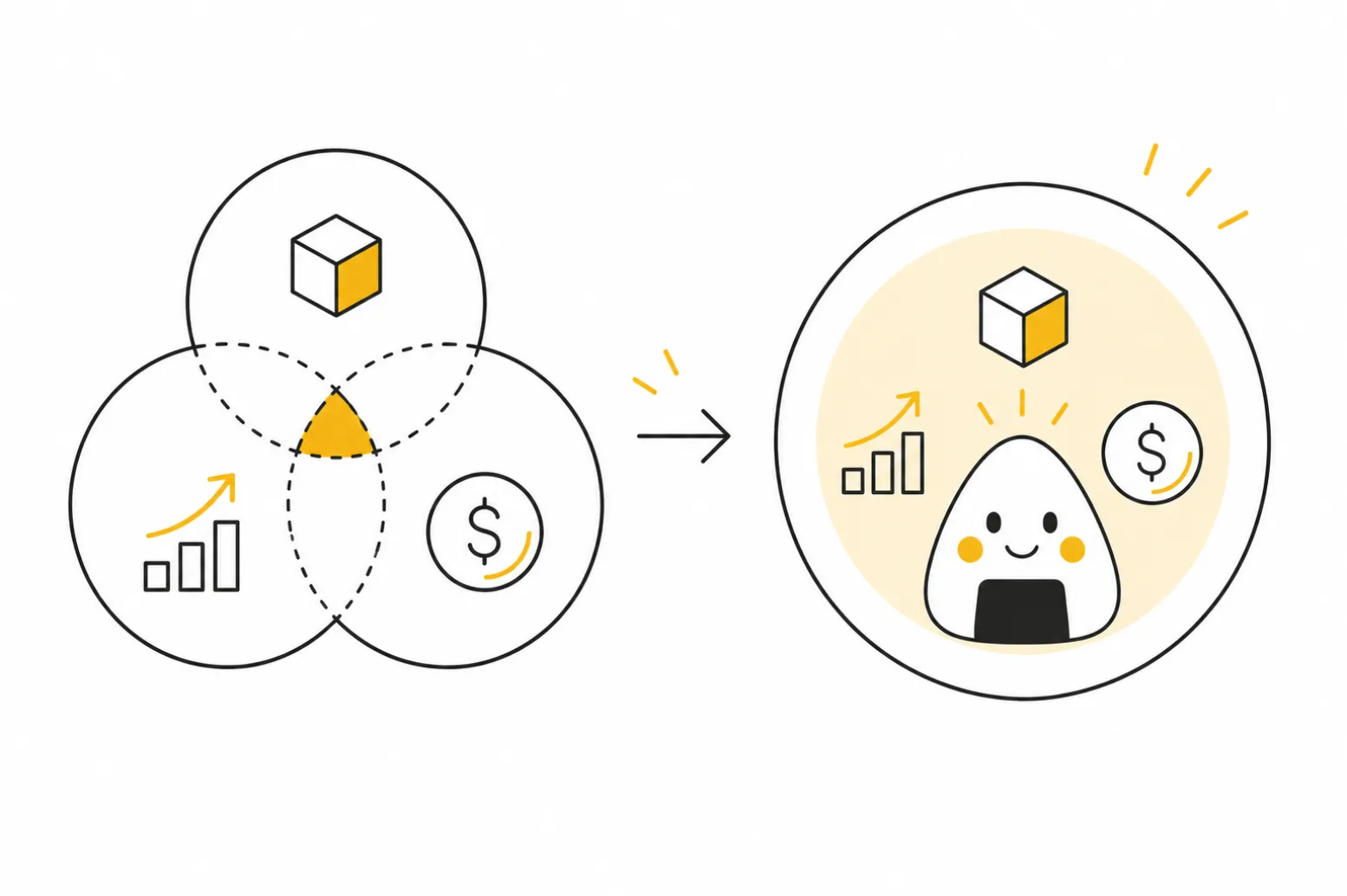
Table of Contents
Over the past two years, leadership has fixated on how to do more with less but faster. Layoffs and influencers boosted posts like “the PM role is dying,” “if you’re not doing x, you’re falling behind,” and other anxiety-inducing AI slop. But “perception is reality,” plus just by leveraging basic AI tools, you save more than 50% of the old PM work. So how do Product roles add value now? You get a hint of these in some job ads via hybrid titles: Growth PM, AI Strategy Lead, Revenue Product Manager, and many related combos.
While we saw at some Product People clients that the product team took a hit and was retrofitted by cost-cutting pressure under tech, the more successful companies we serve gave it a long-overdue upgrade. Some merged Product and Growth as Airbnb famously did last year. PLG (Product-Led Growth) and similar approaches also helped solidify the trend. Other companies merged Product, Revenue/Business, and Strategy, and so on and so forth.
And while some tried having fewer PMs since dev teams are smaller, others ramped up hiring PMs as rapid exploration of the right opportunities became the bottleneck, especially in B2B SaaS where you cannot really dodge talking to customers as easily as you can in B2C—especially when you’re working with complex enterprise accounts bringing in 7+ figures.
What’s In and What’s Out
Historically, a huge chunk of a Product Manager’s time went to low-leverage operational work: taking meeting notes, coordinating handoffs, grooming backlogs, slicing user stories, prototyping or building flows.
Freeing up 50% of a PM's weekly capacity lets them focus on what actually moves the needle: shaping go-to-market strategy, navigating B2B sales cycles, optimizing unit economics, and driving retention and what have you.
Intentional Tension vs. Org Bloat
Blending Product and Growth into one function is a direct antidote to the bloated org charts that spread during the cheap-capital era before 2022.
In a retail legacy or matrixed organization, we’ve found a Business Analyst, a Product Owner, and a Product Manager all on the same workstream. It was the digital division of a brick-and-mortar supermarket chain outside of the tech hubs, so we didn’t hold it against them for not knowing any better and tried to help. We proposed to the CPO to keep one person instead of three on that workstream; the pushback was that the “Business Analyst and Product Owner came as a package with the developers from the external agency we retained.” Of course they did, it’s in their interest to want to create more billable days for their devs. This was an even stronger reason to not have them staffed on the same workstream, as their incentive was towards creating more work for the company that placed them there rather than thinking how to do things faster, better, or, if relevant, do at all. So we ended up wasting hours in alignment meetings and Miro boards defining where one role ended and another began, and figuring out various ways to bypass internal politics and gatekeepers just to run customer discovery interviews.
A scaleup we recently helped create AI-native product teams by consolidating six fragmented product pillars into three small, high-leverage teams. They can go from prompt to prototype in less than an hour compared to weeks.
GTM vs. Marketing Ops
Blending product and growth is good; having role boundaries so PMs don't become swamped with repetitive marketing work is better.
A Growth PM should be involved in GTM testing, running targeted ad experiments on social media to validate value propositions, testing CRM sequences, like activation/reactivation. Once an acquisition channel becomes a repeatable playbook, execution should go to marketing operations, which can have a good degree of automation. PMs shouldn't be running daily CRM campaigns or managing ongoing ad spend.
Setting that boundary takes explicit capacity allocation. Four years ago, on a client at a major travel marketplace, our team managed three acquisition pillars: Organic, Paid Acquisition, and Partnerships. To stop the Paid PMs from turning into an ad hoc scripting service for marketing, we put a strict 10% to 15% cap on ad hoc operational requests (turning off all ads in a location due to strikes, volcanic eruptions, etc). This forced the team to build automated tooling instead of just absorbing the manual work. Product builds leverage. Operations runs playbooks.
AI EVALs and Sales Revenue Attribution
Another discussion point is which team is responsible for writing, running, and maintaining different types of AI EVALs, including for agents. Product defines the customer use cases; Engineering builds regressions and the evals.
When a product team owns revenue, it can create friction with sales teams without a holistic incentive structure. If the Product drives self-serve renewals and upgrades, what happens to the sales commissions? Orgs that get this right by designing unified incentive structures where product feeds the sales pipeline instead of competing with it, so the farming and hunting teams stay in sync.
The Future of Titles in Moot
Will job titles keep morphing into a keyword salad? Or will we see a swing back toward radical simplification? Nobody cares.
We're already seeing both. Companies like Anthropic have pushed toward title compression with roles like Member of Technical Staff, while Stripe has historically avoided complex external titles in favor of internal levels. Much like the skincare brand The Ordinary stripped away marketing buzzwords to name products after their active ingredients like "Hyaluronic Acid", the industry may eventually get tired of unnecessarily ornate titles and land back on simplicity.
Whether your business calls the role Growth PM, AI Product Manager, or whatever, it’s fine. Perhaps stay away from Product Owner and Business Analyst as it signals you’re stuck in the 90’s.
Conclusion: You Do You
It’s the best time ever to think from first principles what would be the ideal setup for your org and where you’d benefit from merging responsibilities and changing how things are. As long as you can measure the effects on growth and revenue while team retention is stable and the end user doesn't see the handoff between departments, you’re all good.

Interested in working with us?
Our Interim/Fractional Product Managers, Owners, and Leaders quickly fill gaps, scale your team, or lead key initiatives during transitions. We onboard swiftly, align teams, and deliver results.
Read More Posts
September 18, 2026
User Stories Explained: Format, Examples, and Template
Learn the user story format, see real examples, and grab a free template to write clearer, more useful agile backlogs.

September 16, 2026
Onboarding Software: How Product Teams Choose and Use It
Onboarding software splits into HR and product categories. See how to map the user onboarding process, pick tools, and learn from real examples.

September 14, 2026
Measuring App Performance: A Product Metrics Framework
Learn how to measure app performance with a product metrics framework built for B2B teams, plus real examples and benchmarks to guide what to track.