
Onboarding Definition: What Product Teams Need to Know
What onboarding means for product teams: from user onboarding and product onboarding to the tools and experiences that drive retention.


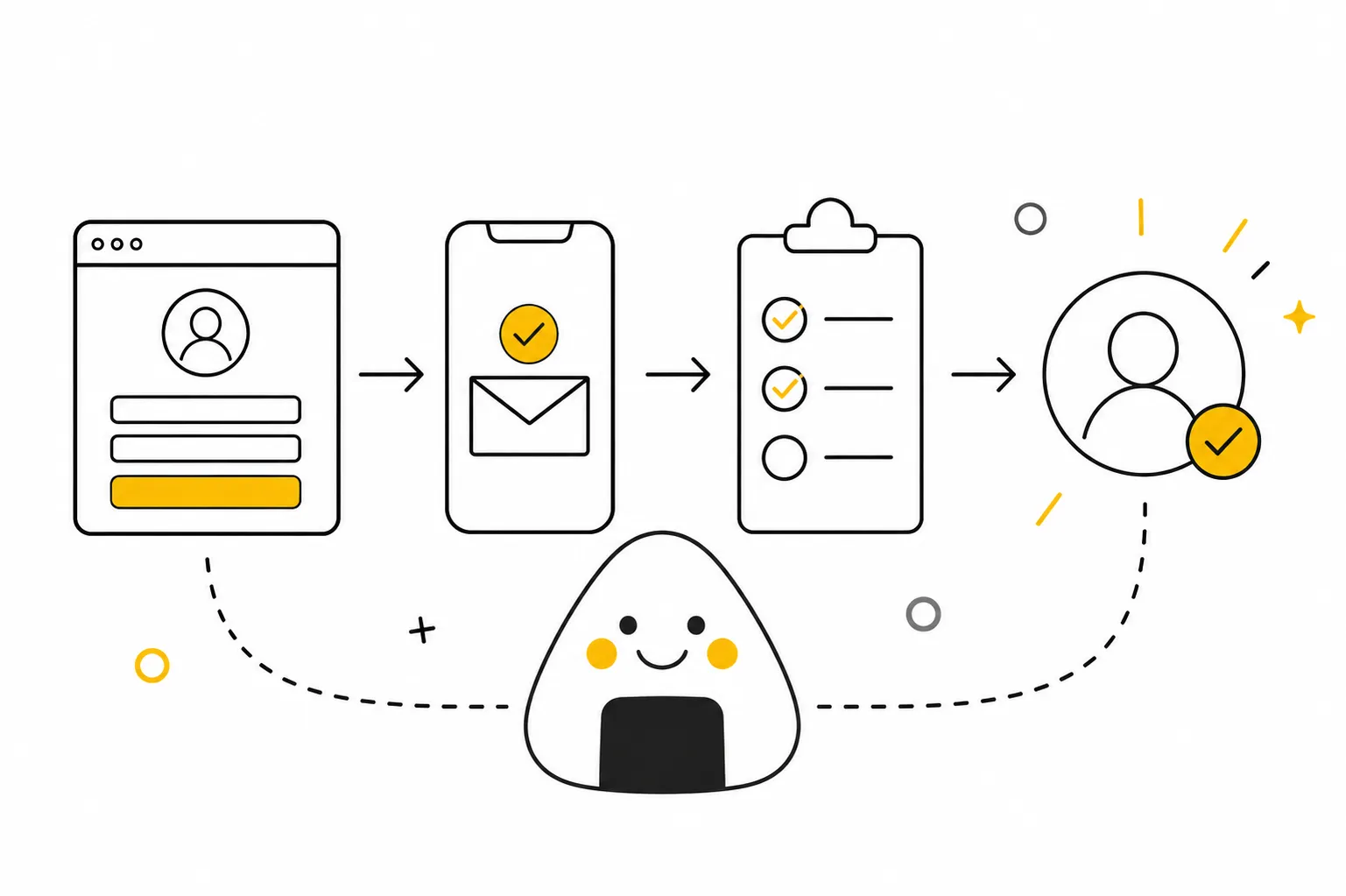
Table of Contents
Audio
Onboarding is the process of guiding new users from their first interaction with a product to their first meaningful moment of value. It is not a welcome screen or a feature tour. It is the full arc a user moves through as they go from unfamiliar to capable, from skeptical to engaged. For product teams, the onboarding definition matters most at the places where it gets blurry: where onboarding ends, who owns it, and what success actually looks like.
Most organizations use the term loosely, and that creates real problems. Some teams equate onboarding with a product tour. Others treat it as a customer success function that kicks in after the sale closes. But an accurate onboarding definition covers every touchpoint from first click to sustained usage: in-product guidance, triggered emails, support documentation, and the activation event that determines whether a user stays or churns.
This article walks through what onboarding means in the context of product management, why the onboarding experience is one of the highest-leverage areas for retention, and what approaches and tools product teams use to build onboarding that actually works.
User Onboarding: The Experience That Drives Retention
User onboarding describes the experience a person has when they first engage with your product and work toward an initial moment of value. The framing matters: user onboarding centers the user's goals, not the company's feature list. A new user does not care about your data import flow. They care about whether their problem will be solved. Strong user onboarding keeps that perspective at the front of every design decision.
According to Wyzowl's customer onboarding research, 55% of people have returned a product because they did not understand how to use it. In SaaS, that abandonment is silent. Users do not file complaints or request refunds. They simply stop logging in. This makes the onboarding experience one of the most consequential product surfaces a team can invest in, and one of the most frequently underbuilt.
An effective user onboarding experience moves through three core phases:
- Activation: Getting the user to a meaningful first action as quickly as possible. Activation events are the most predictive leading indicator for long-term retention. The faster users get there, the lower the churn risk in the first 30 days.
- Value demonstration: Connecting product capabilities to outcomes the user already cares about. Features explained without context rarely create lasting behavior change. The question to answer for the user is "what does this mean for me," not "what does this do."
- Habit formation: Using in-app prompts, progress indicators, and triggered messages to bring users back until the product becomes a default tool in their workflow.
The most common failure in user onboarding is the gap between signup and first use. Teams build sophisticated products and expect users to discover the value on their own. That gap, often called the activation gap, is where most early churn begins. Closing it requires a product-led approach to onboarding that treats the in-product experience as the primary driver of adoption, not a post-sale process managed by customer success.
What Product Onboarding Actually Involves
Product onboarding is the end-to-end system a company builds to help new users adopt its product. Where user onboarding describes the experience from the user's perspective, product onboarding describes the operational process from the company's side. The distinction is useful when deciding who owns what: product owns the in-app experience, marketing owns triggered messaging, and customer success owns high-touch onboarding for enterprise accounts.
A complete product onboarding system typically includes:
- In-product flows: Checklists, progress bars, empty states, tooltips, and interactive walkthroughs that guide users through core functionality without requiring them to read a manual
- Lifecycle emails: Triggered messages based on user actions or inaction, designed to re-engage users who have stalled or to reinforce momentum for those who are progressing
- Help content: Documentation, video tutorials, and contextual support that answer questions at the moment users encounter them, inside the product
- Human touchpoints: For enterprise or high-value customers, a CS or sales-assisted onboarding layer covering configuration, goal-setting, and stakeholder alignment
At the center of every product onboarding decision is the activation milestone: the specific moment when a user has done enough to experience the core value of the product. Every element in the onboarding system should be evaluated against whether it reduces friction on the path to that moment.
ProductLed's State of B2B SaaS 2025 report, which analyzed 446 companies, found that businesses with self-serve onboarding scored 18.3% higher on time-to-value delivery than those relying on manual onboarding. That gap translates directly into retention numbers. The teams compressing time-to-value are winning on churn, not just on speed.
Product onboarding also needs to scale with the user. First-time users need guidance. Power users need progressive disclosure and access to advanced capabilities. Dormant users who re-engage need a different sequence entirely. Treating product onboarding as a static linear flow misses how users actually grow. Modular onboarding, composable enough to adapt to where a user is rather than just who they were on day one, is what separates mature onboarding systems from basic ones.
Onboarding Tools That Product Teams Actually Use
Onboarding tools are the platforms and infrastructure product teams use to build, test, and optimize the onboarding experience without requiring a full engineering sprint for every adjustment. The market has expanded significantly over the last five years, and most mature teams layer several tools together rather than relying on a single platform to handle everything.
The main categories:
In-product guidance platforms: Tools like Pendo, Appcues, Chameleon, and UserGuiding let product and growth teams create in-app flows, tooltips, checklists, and modals with minimal code changes. These are the primary surface for user onboarding investment and are typically the first tool teams adopt.
Analytics and event tracking: Tools like Amplitude, Mixpanel, and Heap are not onboarding tools in the traditional sense, but they are essential for identifying where users drop off. Without event tracking, teams cannot locate the activation gap or measure whether onboarding changes are producing results.
Lifecycle email and messaging: Tools like Customer.io, Intercom, and Braze let teams trigger messages based on what users have and have not done. Email remains one of the highest-converting channels for re-activating users who have stalled mid-onboarding flow.
In-product support: Intercom, Zendesk, and Freshdesk provide in-app chat and support options that reduce friction for users who get stuck. The ability to ask a question without leaving the product is a meaningful factor in completing the onboarding flow successfully.
The most important selection criterion for onboarding tools is integration depth: how well the tool reads your user data, connects to your analytics stack, and feeds into your CRM. A standalone onboarding tool that cannot access user properties produces generic experiences that feel irrelevant. Research aggregated by Custify shows that customers who complete onboarding have a 21% higher lifetime value on average, which makes the business case for proper tooling investment straightforward.
Building effective product team onboarding processes starts with analytics before it starts with adding new tools. Before layering in more in-app guidance, understand where users are currently dropping off. The intervention should follow the data, not precede it.
FAQ
Conclusion
Onboarding is not a feature, a screen, or a sprint. It is an ongoing system that sits at the intersection of product design, communication, and customer success. Teams that treat the onboarding definition narrowly tend to lose users before those users ever experience the value that would have kept them.
The clearest first step is measurement. Map where users drop off, define the activation milestone that predicts retention in your specific product, and build the onboarding experience backward from there. The tools and tactics are secondary to having that directional clarity first.

Interested in working with us?
Our Interim/Fractional Product Managers, Owners, and Leaders quickly fill gaps, scale your team, or lead key initiatives during transitions. We onboard swiftly, align teams, and deliver results.
Read More Posts
September 18, 2026
User Stories Explained: Format, Examples, and Template
Learn the user story format, see real examples, and grab a free template to write clearer, more useful agile backlogs.

September 16, 2026
Onboarding Software: How Product Teams Choose and Use It
Onboarding software splits into HR and product categories. See how to map the user onboarding process, pick tools, and learn from real examples.

September 14, 2026
Measuring App Performance: A Product Metrics Framework
Learn how to measure app performance with a product metrics framework built for B2B teams, plus real examples and benchmarks to guide what to track.