

Customer Journey Map: A Practical Guide for Product Teams
Learn what a customer journey map is, explore real examples, and discover how AI tools are transforming digital customer journey mapping for product teams.


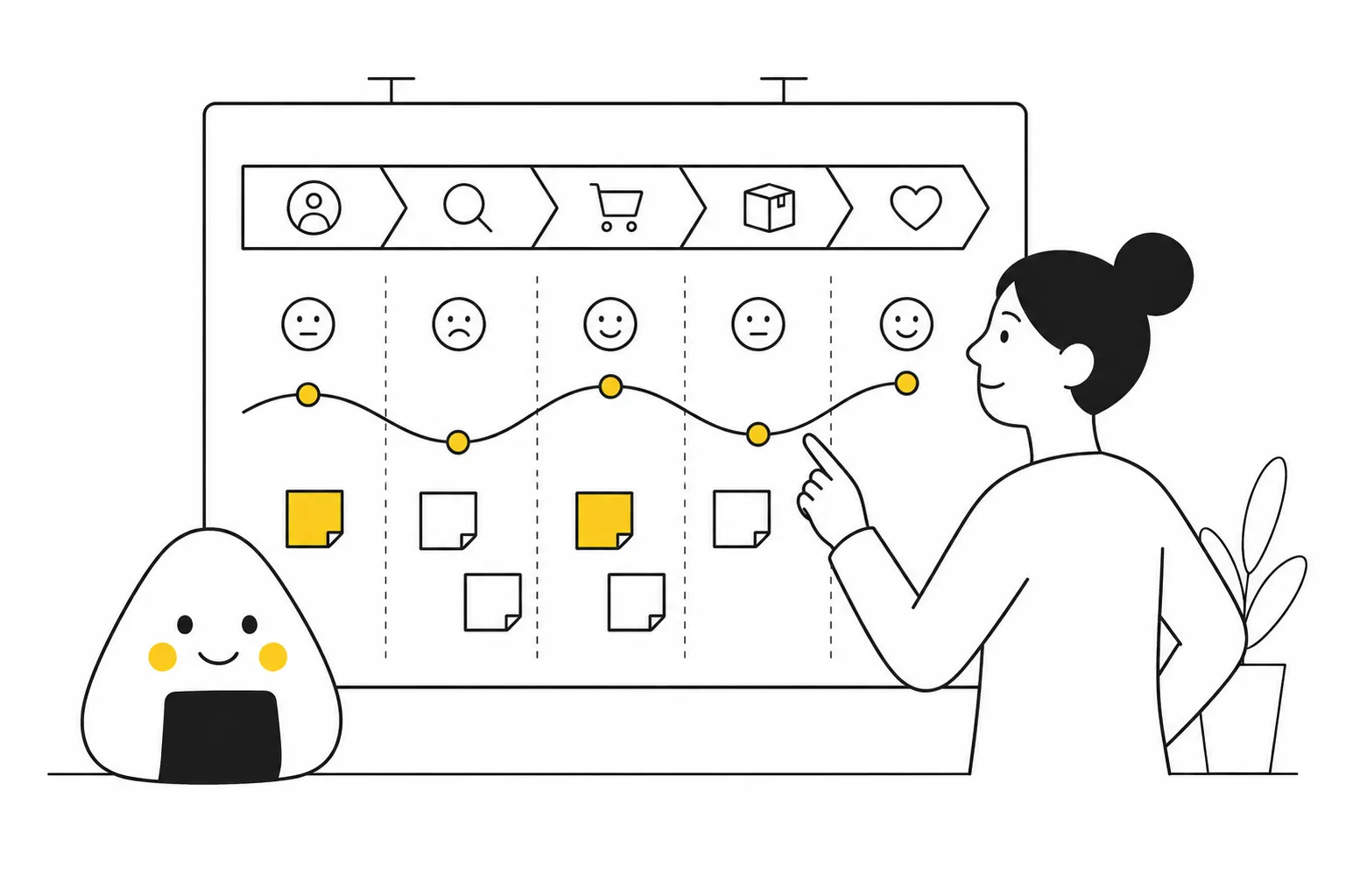
Table of Contents
A customer journey map is a visual representation of every interaction a customer has with your product or brand, from first awareness through post-purchase. It captures not just what customers do, but what they think and feel at each step. That combination makes the gap between your team's assumptions and the actual customer experience visible in a way that data alone cannot.
Most product teams already know where their metrics look bad. Drop-off rates, churn spikes, and activation lags all signal that something is wrong. What journey maps add is the reasoning behind those signals. They give cross-functional teams a shared picture of the experience from the customer's point of view, rather than through the lens of each department's own metrics and priorities.
This guide covers what an effective customer journey map looks like in practice, how digital contexts have changed the discipline, and which tools, including AI-powered ones, are genuinely worth using.
Examples That Drive Real Decisions
Most teams encounter two types of customer journey maps: current-state and future-state. Current-state maps document what customers actually experience today, including friction, workarounds, and emotional low points. Future-state maps describe the intended experience after a redesign or new feature ships. Both serve distinct purposes and warrant building at different moments in the product lifecycle.
A B2B SaaS onboarding map is one of the most common examples in product management. It typically covers five stages: awareness, sign-up, first use, repeated use, and renewal or churn. At each stage, the map tracks what the customer is doing, what they are thinking, and what they are feeling. Pain points cluster almost universally in the "first use" stage, where customers encounter configuration complexity, unclear UI states, or a mismatch between what they expected and what they found.
A B2C e-commerce map follows the same logic but looks different in structure. The stages run from search and discovery through product comparison, cart, checkout, delivery, and return. Emotional tracking typically shows the highest anxiety at checkout (payment friction, unclear delivery timelines) and the lowest satisfaction during returns. Each of those low points is a design and operations problem with a real fix.
What makes these examples useful is specificity. According to Nielsen Norman Group's journey mapping research, maps built for a single persona in a single scenario tell a clear story. Maps that try to represent all customer types at once lose the precision that makes them actionable.
A few elements that consistently appear in journey maps that drive actual decisions:
- Stage labels aligned to the customer's goal, not to internal process steps
- Verbatim quotes from customer interviews anchoring the emotional track
- Explicit ownership assigned to each touchpoint
- Opportunities linked directly to the pain points uncovered in research
The full process for building a map from scratch, including how to structure your research and synthesize findings, is covered in the Product People guide to customer journey mapping steps, tools, and impact.
Digital Customer Journey Mapping in Practice
Digital journeys are more complex than traditional ones because customers move across channels without any predictable sequence. A Google search leads to a landing page, then a product review on Reddit, then a trial sign-up from a retargeting ad, then an onboarding email sequence. That non-linear path is difficult to capture from any single internal data source.
Digital customer journey mapping addresses this by layering behavioral data on top of the qualitative research that journey mapping has always required. Session recordings, click tracking, funnel analytics, and support ticket tags all become inputs alongside user interviews and surveys. The challenge is synthesis. Analytics platforms show what users do, but not why. The "why" always comes from direct conversation with customers, which is where customer discovery becomes essential.
Effective digital journey maps surface several things that internal data alone cannot:
- Channel switching behavior: Where do customers move from one channel to another, and why? If users research on mobile but complete purchases on desktop, that transition is a touchpoint that requires explicit attention.
- Asynchronous interactions: Digital customers rarely move through a journey in a single session. A customer may research for three weeks before purchasing. Maps need to account for that time dimension, including the content and touchpoints that influence the decision between sessions.
- Invisible touchpoints: Peer reviews, community forums, and third-party comparison sites shape digital journeys in ways that do not appear in your internal analytics. These touchpoints belong on the map even when direct data is limited.
A practical approach is to layer your data sources. Start with analytics to identify where drop-off happens. Use session recording tools to observe what users do at those friction points. Then run interviews to understand why. The journey map becomes the synthesis layer that connects all three and makes the picture usable across teams.
Digital maps also need more frequent updates than traditional ones. Customer behavior online shifts quickly with product changes, competitive moves, and platform algorithm updates. A digital journey map treated as a quarterly living document is more valuable than one produced as a one-time deliverable and filed away.
AI Customer Journey Mapping Tools Worth Using
AI is changing how fast teams can build and update journey maps, particularly the stages of synthesis and drafting that previously consumed most of the time. The research underneath a map still needs to come from real customers. What AI tools can replace is the manual labor of organizing and visualizing what that research reveals.
According to Forrester's January 2026 research on customer journey management, generative AI is reducing the cycle time for journey drafting significantly. However, organizations are adopting these tools carefully because executives require human oversight, transparent sourcing, and governance frameworks before AI-generated maps inform strategic decisions.
The tools most commonly used by product teams fall into three categories:
Diagramming and collaboration platforms such as Miro, FigJam, and Lucidchart are not AI-native but have added features for generating map templates, summarizing sticky note clusters, and synthesizing workshop outputs. They work well for distributed teams running collaborative mapping sessions.
Research synthesis tools such as Dovetail, Grain, and Notion AI ingest interview transcripts and surface themes, sentiment patterns, and pain point clusters automatically. These tools cut the time between collecting customer research and extracting usable insights significantly.
AI-native journey management platforms such as Smaply, Cemantica, and Medallia with AI features are purpose-built for teams running journey programs at scale. They connect maps to customer data platforms, auto-update journey stages based on behavioral signals, and link identified pain points to operational KPIs. These are most appropriate for enterprise CX teams managing multiple journey programs simultaneously.
For most product teams starting a journey mapping practice, a combination of interviews synthesized with a tool like Dovetail and visualized in Miro is sufficient. The AI-native platforms earn their complexity when you are managing multiple maps, running continuous discovery, or trying to connect journey performance directly to financial outcomes.
The primary risk with AI tools is using them to skip the research phase. A well-structured AI-generated map built without customer input is a hypothesis. Teams that bypass interviews and rely on AI to fill in what customers think and feel produce outputs that look professional but are built on assumptions. Customer research is what makes a journey map a reliable artifact.
FAQ
Build a Map You Will Actually Use
A customer journey map delivers value in proportion to how well it is grounded in real customer data and how directly it connects to team decisions. Maps built from assumptions and filed as deliverables rarely change anything. Maps built from interviews, updated regularly, and linked to product work do.
Start with one persona and one scenario, conduct the research, and build something specific enough to be challenged. Once the habit is established, the tools, including the AI-powered ones, become genuine accelerators rather than shortcuts around the hard work.

Interested in working with us?
Our Interim/Fractional Product Managers, Owners, and Leaders quickly fill gaps, scale your team, or lead key initiatives during transitions. We onboard swiftly, align teams, and deliver results.
Read More Posts
October 19, 2026
How a Convenience Survey Works and When to Trust the Results
A convenience survey is fast and cheap, but easy to misread. Learn how convenience sampling works, where it misleads, and when product teams can use it.

October 19, 2026
Usability Testing: Methods, Types, Tools and Examples
Usability testing shows where real users get stuck. Learn the main types and methods, which tools to use, and how to run a first test this week.

October 20, 2026
Some CPOs are more CPOs than others
Influence can take a product leader part of the way. How far they get depends on the mandate behind them, and that gets settled before day one.