

Customer Experience (CX) Design: A Practical Guide
Customer experience (CX) design shapes every brand touchpoint. Here's what it means, why it matters, and how to build a strategy that works.


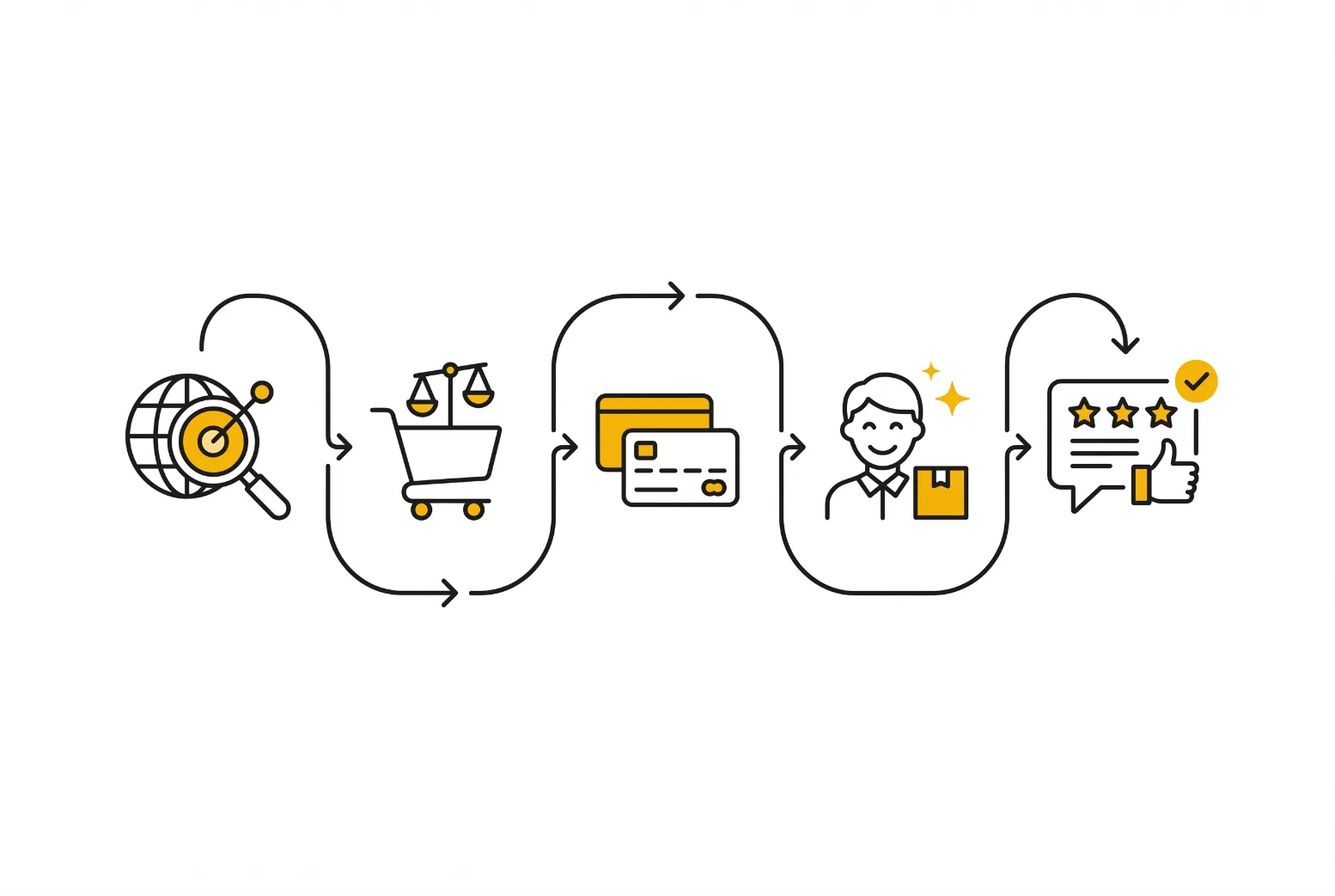
Table of Contents
Customer experience (CX) design is the practice of deliberately shaping how someone feels at every point they interact with a company, not just inside the product they bought. That includes the sales call, the invoice email, the return policy buried on page four of a PDF, and the ten minutes spent on hold with a chatbot that keeps misreading the question.
Most product organizations already have someone accountable for the app or website. Far fewer have anyone accountable for what happens before a customer opens it or after they close it. That gap between "the product is great" and "the company is a pain to deal with" is exactly where CX design earns its keep.
We once worked with a client whose onboarding flow had clearly been through a dozen usability rounds, smooth, well-labeled, genuinely pleasant. Their returns process, meanwhile, lived in a PDF three clicks deep and referenced a phone number that had been disconnected for a year. Users loved the app and complained about the company in the same review. That contradiction is the whole case for treating CX design as its own job, not a side effect of good UX.
What Is Customer Experience (CX) Design?
CX design is often confused with UX design, and the confusion is understandable because the two overlap constantly. Nielsen Norman Group frames the difference as one of scope rather than substance: a single interaction, like resetting a password, sits at the interaction level. Stitching several interactions together into a goal, like switching insurance providers, sits at the journey level. Everything a customer experiences with a brand over the life of the relationship sits at the relationship level. UX designers usually own the first. CX design has to own all three, which is why it pulls in marketing, sales, support, and operations, not just the design team.
In practice, this means a CX designer cares about things a UX designer typically doesn't: how a refund is worded in an email, whether the sales deck promises a feature that shipped differently, whether the same discount code works the same way on the website and in the app. None of that lives inside a single screen. It lives in the seams between departments, which is usually where customers notice the company stopped paying attention.
This is also why CX design rewards people who are comfortable with ambiguity. There's no single Figma file that represents "the customer experience." Instead there's a map of touchpoints, most of which are owned by teams who have never spoken to each other, and the job is making that patchwork feel like one relationship. Our guide to user experience basics is a useful starting point if your team is still building out the UX side of that foundation before tackling CX as a whole.
Building a Customer Experience Design Strategy
A customer experience design strategy starts with admitting you don't actually know where customers get frustrated, because most of that friction happens outside the systems your analytics track. A support ticket queue, a sales call transcript, and a churn survey usually tell three different, contradictory stories, and the strategy work is reconciling them into one map.
Start by mapping the journey end to end, including the parts your team doesn't own. Our customer journey mapping guide walks through how to do this without it turning into a wall of sticky notes nobody revisits. The map should surface where ownership breaks down: the moment a customer moves from the marketing site to the app, from a sales rep to a support agent, from a free trial to an invoice.
Once the friction points are visible, prioritize by which ones actually predict churn or advocacy, not which ones are loudest in a stakeholder meeting. This matters more than most strategy documents admit. Forrester's 2024 US Customer Experience Index found that only 3% of companies qualified as truly customer-obsessed, and those companies grew revenue 41% faster than their peers. That gap wasn't closed by a better app. It was closed by companies that treated CX as something to be measured and staffed, with clear owners for cross-functional friction points, rather than a value statement on a slide.
A strategy also needs a decision rule for tradeoffs, because CX and short-term revenue will occasionally pull in opposite directions. Write down, in advance, what you'll do when a growth tactic (an aggressive upsell pop-up, a hard-to-cancel subscription flow) technically works but erodes trust. Teams that skip this step end up relitigating the same argument every quarter.
Core Customer Experience Design Principles
The customer experience design principles that hold up under pressure are less about aesthetics and more about what happens when something goes wrong. Harvard Business School's Stefan Thomke has studied why some companies turn service failures into loyalty and others turn them into one-star reviews, and the pattern he found was specific: employees who could act immediately, without needing to escalate or read from a script, created the moments customers actually remembered and repeated to friends.
A few principles follow from that pattern:
- Empower the people closest to the problem. If a support agent needs three approvals to issue a refund, the company has designed friction into the exact moment friction is most costly.
- Design for the failure case, not just the happy path. A shipping delay, a billing error, or a confusing invoice will happen to someone. What they experience in that moment shapes their opinion of the whole brand more than the ten times everything worked fine.
- Keep the tone consistent across channels. A cheerful chatbot paired with a legalistic cancellation flow reads as bait and switch, even when nobody intended it that way.
- Measure emotion, not just completion. A customer can finish a task and still leave annoyed. Surveys and support transcripts both catch this in ways clickstream data alone won't.
None of this requires exotic tooling. It requires someone with the authority to say a policy is bad for customers even though it's good for a quarterly metric, and enough organizational weight to actually change it.
Good CX design rarely comes from a single redesigned screen. It comes from someone tracing a customer's path across departments that don't normally compare notes, and fixing the seams where the experience quietly falls apart.
If your product team owns the app but nobody owns what happens around it, that's the gap to close first. Map the full journey, give someone real authority over the friction points that surface, and revisit the map every time a new channel or handoff gets added.

Interested in working with us?
Our Interim/Fractional Product Managers, Owners, and Leaders quickly fill gaps, scale your team, or lead key initiatives during transitions. We onboard swiftly, align teams, and deliver results.
Read More Posts
October 19, 2026
Usability Testing: Methods, Types, Tools and Examples
Usability testing shows where real users get stuck. Learn the main types and methods, which tools to use, and how to run a first test this week.
October 20, 2026
Some CPOs are more CPOs than others
Influence can take a product leader part of the way. How far they get depends on the mandate behind them, and that gets settled before day one.
January 28, 2026
Mastering Product Prioritization with the RICE Score
Master the RICE score framework to prioritize your product roadmap with data. Learn how to calculate reach, impact, confidence, and effort to align stakeholders and maximize ROI.