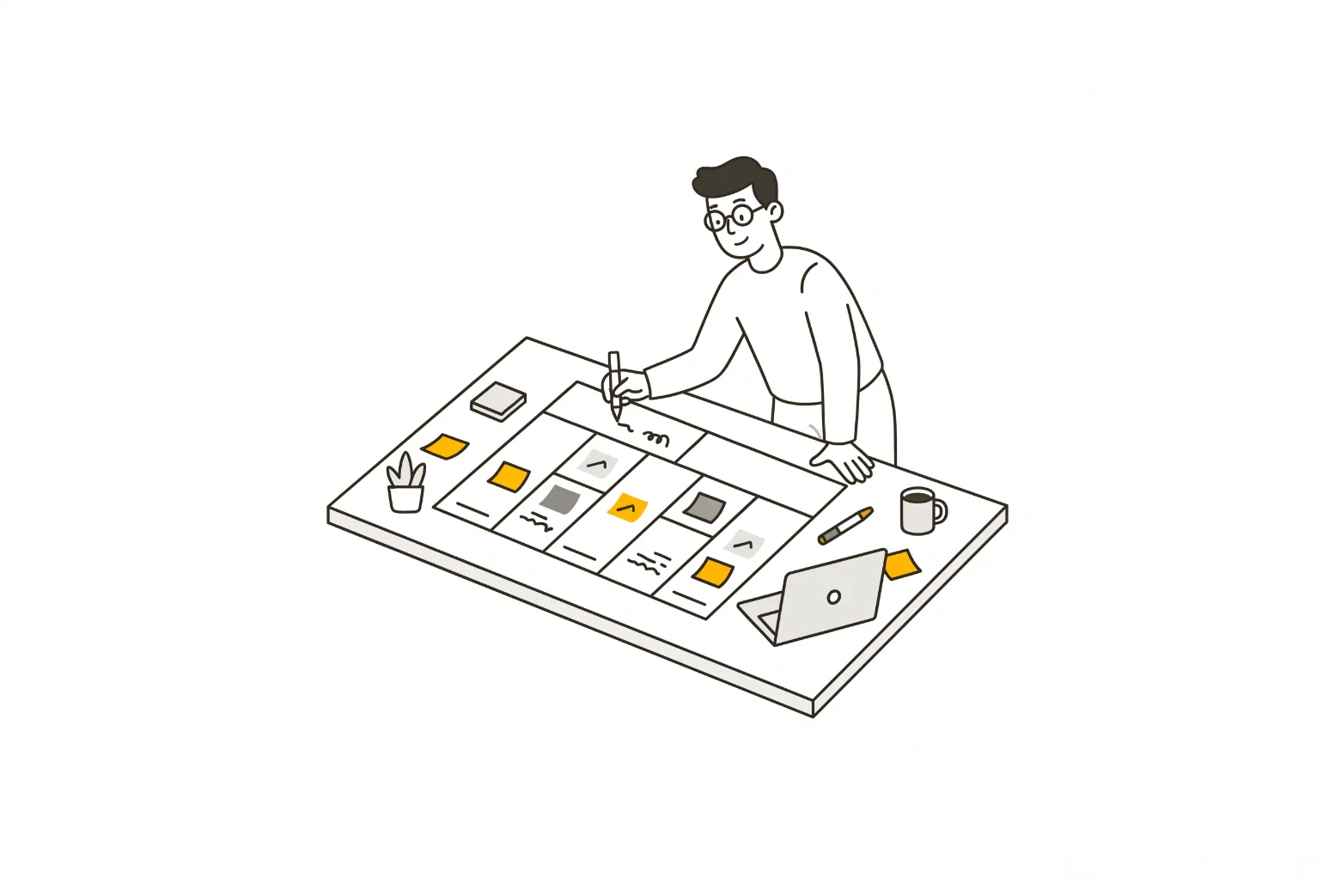

AI Enablement: Stop Automating the Heavy Lifting and Start Solving for Strategy
The high-impact Product Leader of the future is not the one who knows the most prompts. It is the leader who knows how to leverage AI to clear the grunt work and then applies their liberated cognitive energy to critical thinking, judgment, and strategy.


Table of Contents
By Dr. Viktoria Korzhova, CEO & VP of Product at Product People
In the current gold rush of Artificial Intelligence, many organizations are making a fundamental strategic error: they are attempting to outsource judgment to Large Language Models. As a product leader with a background in neuroscience and years of experience scaling product teams, I see companies falling into the trap of trying to AI-ify their roadmaps or automate their strategy without first understanding what AI is actually capable of—and more importantly, what it is not.
The reality is that AI lacks a critical human component: the ability to make a judgment call in a space with limited knowledge of the future. While AI is a statistical mirror of the past, human leaders possess taste—the experience-backed ability to understand what will resonate and which high-stakes decisions to make when the data is incomplete.
To truly enable your product organization with AI, you must stop looking for a fundamental shift in discovery and start focusing on systematic operational excellence.
1. AI is for the Easy Lifting, Not the Heavy Lifting
There is a common misconception that AI should handle the complex, strategic parts of a Product Manager’s job. I argue the opposite. AI is exceptionally good at easy lifting—tasks that are straightforward, structured, and time-consuming but require minimal human judgment.
These include:
- Synthesizing Knowledge: Looking for patterns in existing research or data.
- Documentation: Drafting detailed descriptions based on a structured outline.
- Artifact Generation: Preparing prototypes for experiments or summarizing meeting notes.
When we let AI handle this grunt work, we aren't just increasing speed; we are removing the noise. The heavy lifting of product management—prioritizing features, defining strategy, and managing human stakeholders—remains a human-centric endeavor. AI doesn't replace the PM; it strips away the excuses for not being strategic.
2. The Strategy of Balanced Enablement
How should a leader roll out these tools? I’ve observed that neither a strictly top-down nor a purely grassroots approach is optimal.
If leadership locks down tools under the guise of compliance, they kill the curiosity engine of the team. Conversely, a Wild West approach leads to fragmented workflows and data risks. The sweet spot is a combination:
- Centralized Investment: Provide company-wide access to robust tools that are integrated with your internal data.
- Decentralized Curiosity: Create space for teams to experiment with new tools and pitch them to management.
When leadership openly roots for AI adoption and encourages experimentation, it creates a cultural permission slip. This agency allows PMs to use their natural curiosity to find the best solutions for their specific workflows.
3. Beware the AI-First Product Trap
As a CEO, I often see the pressure to add AI features just because the market is interested. But Product Management is not about applying technology for its own sake. It is about two fundamental questions:
- Will the users benefit?
- Will the ROI exceed the investment?
AI-ifying a product to impress stakeholders is a mistake if it doesn’t solve a core user problem. We must distinguish between Internal Operational Efficiency (using AI to run the product factory better) and the Product Value Proposition. If a PM uses an LLM to write a PRD 50% faster, that’s a win for the organization—but it doesn't mean the customer needs an AI chatbot in your UI.
4. Solving the Inertia of Busyness
The biggest risk of freeing up a PM’s time through AI is that they might fill that vacuum with more unproductive busyness. As humans, we are inclined to do what we already know how to do. If a PM is used to spending 70% of their day in poorly structured meetings, they may continue to do so even when they have the tools to work differently.
The goal of AI enablement is to allow PMs to become more thoughtful and strategic about their human interactions. With the time saved on easy lifting, a PM can:
- Prepare better: Use AI to structure meetings, prepare prototypes, or draft agendas so that human time is spent effectively.
- Think deeply: Move from being a task-executor to a scenario-planner.
- Refine Communication: Spend more time on the nuances of stakeholder management and user empathy—areas where AI cannot compete.
5. A Framework for Accountability: The Product People Approach
At Product People, we’ve found that high adoption doesn't happen by accident; it requires a mix of KPIs and social proof.
- KPI-Driven Excellence: We set specific Key Results around reducing administrative time and improving quality through automation. This makes adoption a core part of operational excellence, not an optional nice-to-have.
- The Show, Not Tell Culture: We host regular sharing sessions where consultants demonstrate how they used AI to solve a specific client problem. Peer-to-peer knowledge exchange is often more persuasive than a mandate from the top.
- Gamified Learning: We’ve implemented internal AI Learning Hackathons. By splitting into teams to tackle tasks—like creating a product requirements document or a prototype—we turn the learning tax into a social, high-energy event.
Conclusion: The High-Impact PM of 2026
The high-impact Product Leader of the future is not the one who knows the most prompts. It is the leader who knows how to leverage AI to clear the grunt work and then applies their liberated cognitive energy to critical thinking, judgment, and strategy.
AI is the engine, but human judgment remains the steering wheel. If you focus your enablement on giving your teams the time to think, you won’t just build faster—you’ll build the right things.

Interested in working with us?
Our Interim/Fractional Product Managers, Owners, and Leaders quickly fill gaps, scale your team, or lead key initiatives during transitions. We onboard swiftly, align teams, and deliver results.
Read More Posts
October 15, 2026
Lean Canvas: What It Is and How to Fill It Out Step by Step
A lean canvas is a one-page plan that turns your startup idea into testable assumptions. See the template, the nine boxes, and how to fill it out.

October 12, 2026
Semantic Differential Scale: How to Measure Perceptions Right
Learn how a semantic differential scale works, when to pick it over a Likert scale, and how to build one that shows how users really perceive your product.
October 9, 2026
Let the numbers do the talking
Senior leaders talk numbers. How to justify roadmap decisions with business impact, and which guardrails tell you when to skip the analysis.