

Define Ideate: What It Means and How Product Teams Do It Well
To ideate is to generate many ideas for a defined problem. Learn how ideation works in design thinking, which tools help, and how to pick ideas worth building.


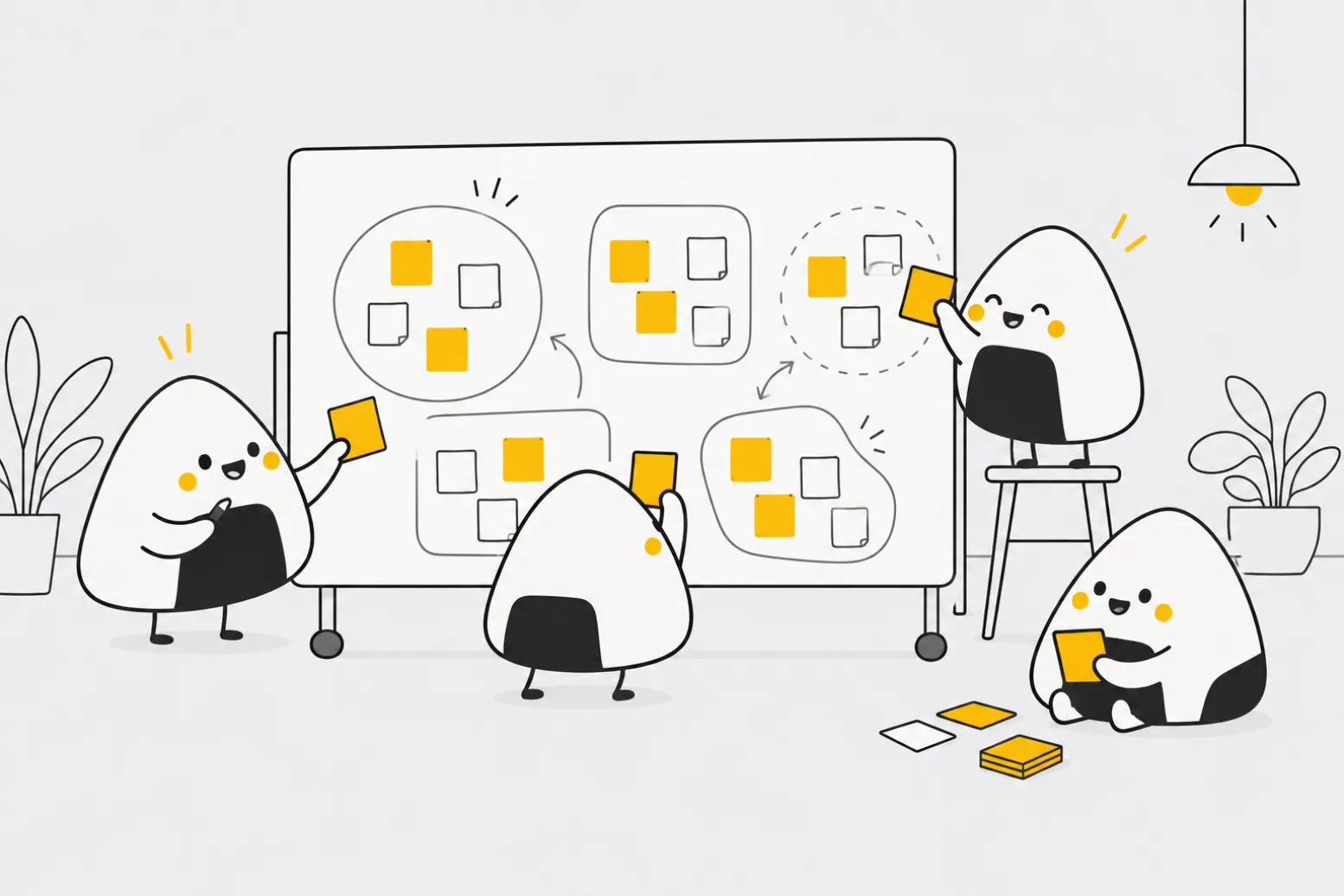
Table of Contents
Audio
To ideate means to come up with ideas, usually many of them, as a deliberate step in solving a defined problem. In product work, "define ideate" is shorthand for two stages that sit next to each other: you pin down the problem, then you generate options before judging any of them.
Most teams skip the first half or rush the second. They land on a solution in the first ten minutes of a meeting, spend the remaining fifty defending it, and call that a workshop. Real ideation is less comfortable. It asks you to keep going after the obvious answers run out, because the useful ideas tend to show up late.
This guide covers what ideation looks like in practice, where it fits in the design thinking process, which tools are worth your time, and how to turn a wall of sticky notes into a decision.
Ideate design thinking: where the step fits
In the classic design thinking model, ideation is the third of five modes: empathize, define, ideate, prototype, test. The Stanford d.school describes these as modes rather than rigid steps, which is a useful reminder that real teams loop back. You will often ideate, learn something in a prototype, and go back to redefine the problem.
The order matters for one reason. Ideation works only when the problem is sharp. A vague problem produces vague ideas. "Improve onboarding" will give you a pile of generic suggestions about tooltips and welcome emails. "New admins abandon setup at the step where they invite their team" gives you something to push against.
So before anyone picks up a marker, write the problem as one sentence and check that the whole room reads it the same way. If two people interpret it differently, you have found your first real task.
Two rules keep the session honest:
- Separate generating from judging. Nobody says "that won't work" during the generating phase, because the moment one idea gets shot down, the quiet people stop contributing.
- Aim for volume first. Quantity gives you room to combine and improve, and the first few ideas are rarely the best ones.
Timing also matters more than most teams admit. The Nielsen Norman Group surveyed 257 UX professionals for Ideation in Practice and found that the teams who rated their ideation as very effective ideate early, use user research as input, and work in groups. That lines up with what we see in the field. Ideation that starts after the roadmap is already decided is mostly theater.
A good example of the format working is a four-day Lean Inception workshop Product People ran to shape the MVP of a new app for a medical apps company, described in this case study. The point was not the number of ideas. It was that the whole team left with the same picture of what to build first.
Ideate tools that make idea generation less painful
You do not need special software to ideate. A whiteboard and a timer will beat most digital tools. Still, a few techniques are worth knowing because each one fixes a specific failure mode.
Brainwriting fixes the loudest-voice problem. Everyone writes ideas silently for five minutes, then the sheets get passed around so people can build on each other's notes. The senior person in the room cannot anchor the group before anyone else has thought for themselves.
Crazy 8s fixes the "we only have one idea" problem. Each person folds a sheet into eight panels and sketches eight different approaches in eight minutes. The time pressure forces you past the first, safest answer.
"How Might We" questions fix the framing problem. You turn a finding from research into an open question, such as "How might we help new admins invite their team without leaving the setup flow?" The Nielsen Norman Group notes in its guide to How Might We questions that the broader the question, the more ideas it can produce, so a question that is too narrow quietly answers itself.
Worst Possible Idea fixes the stuck-room problem. You ask for the most terrible solution imaginable, and then flip each answer. It sounds like a gimmick until you watch a tense team start laughing and, ten minutes later, produce two usable concepts.
Digital whiteboards help when the team is remote, mainly because they make silent writing easy and keep the output in one place. Just remember that the tool is not the technique. A remote session with no timer and no rules will produce the same mess as an in-person one.
One more point on groups. Research on brainstorming is mixed, and some studies suggest people generate more ideas alone than in a group. That is why the best sessions blend both: silent solo generation first, then group discussion to combine and refine. Treat the group as the place where ideas get better, not only where they get produced.
Product ideation: turning ideas into decisions
Generating forty ideas is the easy part. Product ideation is only useful if it ends in a choice, and this is where many teams stall. The wall is full, everyone feels productive, and nobody knows what happens next.
Start by clustering. Group similar ideas, give each cluster a short name, and discard exact duplicates. You will usually find that forty ideas collapse into five or six distinct directions. That is a good result, not a disappointing one.
Then score the clusters against criteria agreed before the session, not after. Three work for most teams:
- Value to the user: does it solve the problem you defined?
- Feasibility: can your team build a first version in a reasonable time?
- Risk: what is the riskiest assumption, and how cheaply can you test it?
Pick two or three directions, not one. The next step is a prototype or a small experiment, and testing a couple of options in parallel is cheaper than being wrong about a single big bet. Do not let the session end without an owner and a date for each experiment.
It is also worth being honest about what ideation cannot do. It will not tell you which idea is right. That comes from testing with real users. What ideation does is widen the set of options so you are choosing between several credible paths instead of defending the first one that came to mind.
The business case for taking this seriously is reasonable, though the evidence has limits. McKinsey's study The Business Value of Design tracked 300 publicly listed companies over five years and found that those in the top quartile of its design index grew revenue about 32 percentage points faster than their industry peers. That is a correlation, not proof that design practices caused the growth. But it supports the idea that disciplined, user-centered work pays off.
If your team struggles to get from ideas to a prioritized plan, an outside product leader can facilitate the process. Our PM consulting team does this regularly with teams that have plenty of ideas and no shared way to choose between them.
FAQs

Interested in working with us?
Our Interim/Fractional Product Managers, Owners, and Leaders quickly fill gaps, scale your team, or lead key initiatives during transitions. We onboard swiftly, align teams, and deliver results.
Read More Posts
October 12, 2026
Semantic Differential Scale: How to Measure Perceptions Right
Learn how a semantic differential scale works, when to pick it over a Likert scale, and how to build one that shows how users really perceive your product.
October 15, 2026
Lean Canvas: What It Is and How to Fill It Out Step by Step
A lean canvas is a one-page plan that turns your startup idea into testable assumptions. See the template, the nine boxes, and how to fill it out.
October 9, 2026
Let the numbers do the talking
Senior leaders talk numbers. How to justify roadmap decisions with business impact, and which guardrails tell you when to skip the analysis.