

Customer Lifetime Value: What It Is and How to Grow It
Learn what customer lifetime value is, how to calculate it with the CLV formula, and proven strategies to increase CLV for your SaaS business.


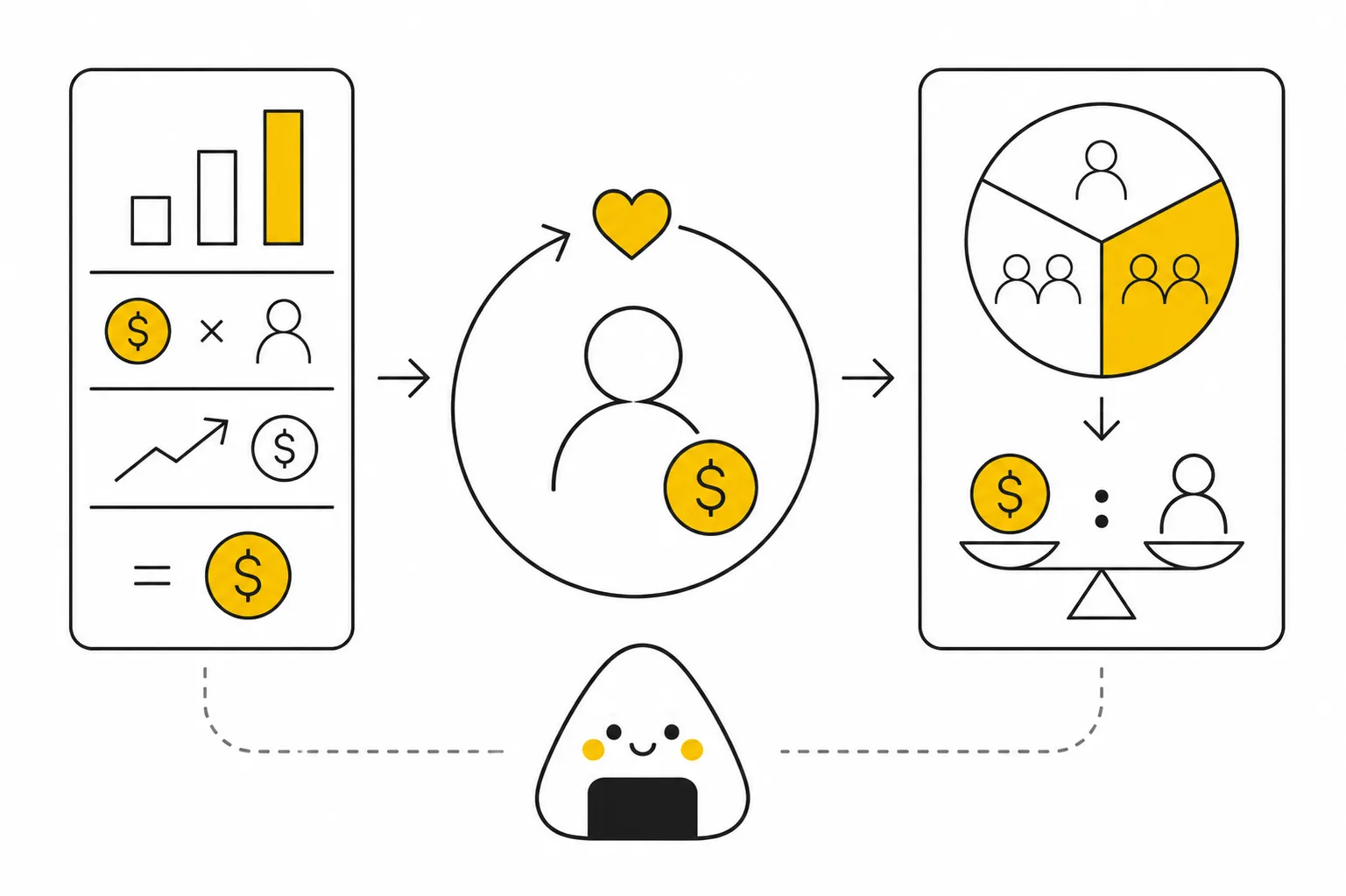
Table of Contents
Audio
Customer lifetime value (CLV) is the total revenue a business can expect to earn from a single customer over the entire course of their relationship. It is one of the most strategically significant metrics in product and growth because it shifts decision-making away from individual transactions and toward long-term profitability.
Most companies track acquisition metrics with precision: cost per click, cost per lead, conversion rates. Far fewer apply the same rigor to understanding what those customers are actually worth once acquired. When you know your CLV, you can set defensible limits on acquisition spend, prioritize retention investments with the highest financial return, and build a product roadmap around the segments that drive the most durable revenue.
This article covers what CLV is, how to apply the customer lifetime value formula to your business, a worked customer lifetime value example for SaaS teams, and the most effective strategies for increasing it.
The Customer Lifetime Value Formula Explained
The customer lifetime value formula comes in several versions. The right one depends on your business model and the data you have available.
Basic formula (transactional businesses):
CLV = Average Purchase Value x Purchase Frequency x Average Customer Lifespan
This works well for businesses with consistent purchase behavior. If a customer spends $80 per transaction, buys four times a year, and stays for three years, their CLV is $960.
SaaS formula (subscription businesses):
CLV = (Average Revenue Per Account x Gross Margin %) / Revenue Churn Rate
This version is more precise for SaaS because it accounts for your actual margins and the rate at which customers leave. If your product charges $600 per month per account, retains 80% gross margin, and has a monthly revenue churn rate of 2%:
CLV = ($600 x 0.80) / 0.02 = $24,000
That figure tells you the average customer is worth $24,000 over their lifetime with your product. It also sets a ceiling on what you can rationally spend to acquire a customer.
The CLV:CAC ratio
The customer lifetime value formula only becomes actionable when paired with customer acquisition cost (CAC). The standard benchmark is a CLV:CAC ratio of 3:1, meaning for every dollar spent acquiring a customer, the business should generate at least three in lifetime value. In 2024 and 2025, leading SaaS companies have been pushing that benchmark toward 4:1 or 5:1, with the gains coming primarily from CLV growth rather than acquisition cost reduction.
CLV calculations built on historical averages become less reliable at scale. Research published in the Journal of Marketing Analytics on CLV prediction in B2B SaaS shows that predictive models incorporating behavioral signals substantially outperform static historical formulas, particularly in high-velocity markets where churn drivers shift quickly.
A Customer Lifetime Value Example for SaaS Product Teams
A concrete customer lifetime value example makes the metric actionable for roadmap and resource decisions. Consider a mid-market B2B SaaS company with three customer segments:
SMB:
- ARPA (monthly): $200
- Gross Margin: 75%
- Monthly Churn: 5%
- CLV: $3,000
Mid-Market:
- ARPA (monthly): $800
- Gross Margin: 80%
- Monthly Churn: 2%
- CLV: $32,000
Enterprise:
- ARPA (monthly): $3,500
- Gross Margin: 82%
- Monthly Churn: 0.8%
- CLV: $358,750
The enterprise segment generates over 100x the lifetime value of SMB. The driver is not just higher ARPA but dramatically lower churn. A 4.2 percentage point difference in monthly churn between SMB and enterprise customers compounds into an enormous value gap over time.
For product teams, this kind of segmentation analysis has direct implications for the roadmap. If enterprise customers churn at 0.8% monthly while SMB customers churn at 5%, the features that support enterprise workflows (advanced admin controls, audit logs, SSO, compliance reporting) have a disproportionately high financial return even when a smaller share of users request them. Prioritizing purely on request volume will systematically underinvest in the segment driving the most revenue.
It also reframes pricing decisions. A customer paying $150 per month who stays for four years generates $7,200 in lifetime revenue. A customer paying $200 per month who churns after six months generates $1,200. Getting the first customer to stay longer is worth far more than acquiring the second.
According to Bain & Company's research on customer lifetime value, marketing leaders who scrutinize CLV alongside traditional ROI metrics are 1.9x more likely to align strategy with actual customer needs rather than channel performance. Companies that redirect budget toward high-CLV segments consistently generate stronger multi-year returns than those optimizing purely for acquisition volume.
Understanding which segments produce the most lifetime value is also a prerequisite for setting meaningful customer retention benchmarks for each part of your customer base.
How to Increase Customer Lifetime Value in SaaS
How to increase customer lifetime value in SaaS comes down to two levers: reducing the rate at which customers leave and growing the revenue each customer generates over time. The most effective strategies move both simultaneously.
Invest in structured onboarding
Poor onboarding is the most common driver of early churn. Customers who do not reach a clear first outcome within their first two to four weeks are significantly more likely to cancel before they have seen enough value to stay. A structured onboarding flow that connects every step to a specific customer goal, rather than to product features, reduces early churn substantially.
Build expansion revenue into the product
Upsell and cross-sell motions work best when triggered by product usage data rather than reactive sales calls. If analytics show a customer is hitting the limits of their current plan, an in-app prompt is more timely and credible than an outbound email. Personalized in-product recommendations can grow per-account revenue by 10 to 30%.
Shift customers to annual contracts
Moving customers from monthly to annual billing reduces churn by up to 50% in SaaS businesses. The effect is both behavioral (the commitment itself lowers cancellation intent) and operational (annual plans eliminate involuntary churn from payment failures). The discount required to incentivize the switch is almost always outweighed by the CLV gain.
Run proactive customer success
Reactive support resolves problems after customers have already decided to leave. Proactive customer success identifies at-risk accounts before they initiate a cancellation. Companies with structured early-warning systems and outreach programs reduce churn by 15 to 25%, which compounds into significant CLV improvements over a customer's full lifespan.
Fix involuntary churn
In SaaS, failed payments account for 20 to 40% of total churn for many businesses. Automated dunning sequences, pre-expiry card update prompts, and account updater integrations are low-effort interventions with a direct impact on retention. Most teams underinvest here relative to the return available.
Churn and CLV move together, but not linearly. A 1% reduction in monthly churn has a compounding effect that grows substantially over the lifetime of a customer relationship. If churn measurement and reduction are not already formalized in your business, this guide to SaaS churn rate reduction is a practical starting point.
FAQ
Start With the Numbers, Then Act on Them
Customer lifetime value is the metric that connects product decisions to business outcomes. When you know what each customer segment is worth, you can invest in retention with the same financial discipline you apply to acquisition, and you can build a roadmap around the customers who drive the most durable revenue.
Start by calculating CLV across your top three customer segments. The differences between them will show you exactly where to focus product and customer success investment first.

Interested in working with us?
Our Interim/Fractional Product Managers, Owners, and Leaders quickly fill gaps, scale your team, or lead key initiatives during transitions. We onboard swiftly, align teams, and deliver results.
Read More Posts
October 19, 2026
How a Convenience Survey Works and When to Trust the Results
A convenience survey is fast and cheap, but easy to misread. Learn how convenience sampling works, where it misleads, and when product teams can use it.

October 19, 2026
Usability Testing: Methods, Types, Tools and Examples
Usability testing shows where real users get stuck. Learn the main types and methods, which tools to use, and how to run a first test this week.

October 20, 2026
Some CPOs are more CPOs than others
Influence can take a product leader part of the way. How far they get depends on the mandate behind them, and that gets settled before day one.