

How a Convenience Survey Works and When to Trust the Results
A convenience survey is fast and cheap, but easy to misread. Learn how convenience sampling works, where it misleads, and when product teams can use it.


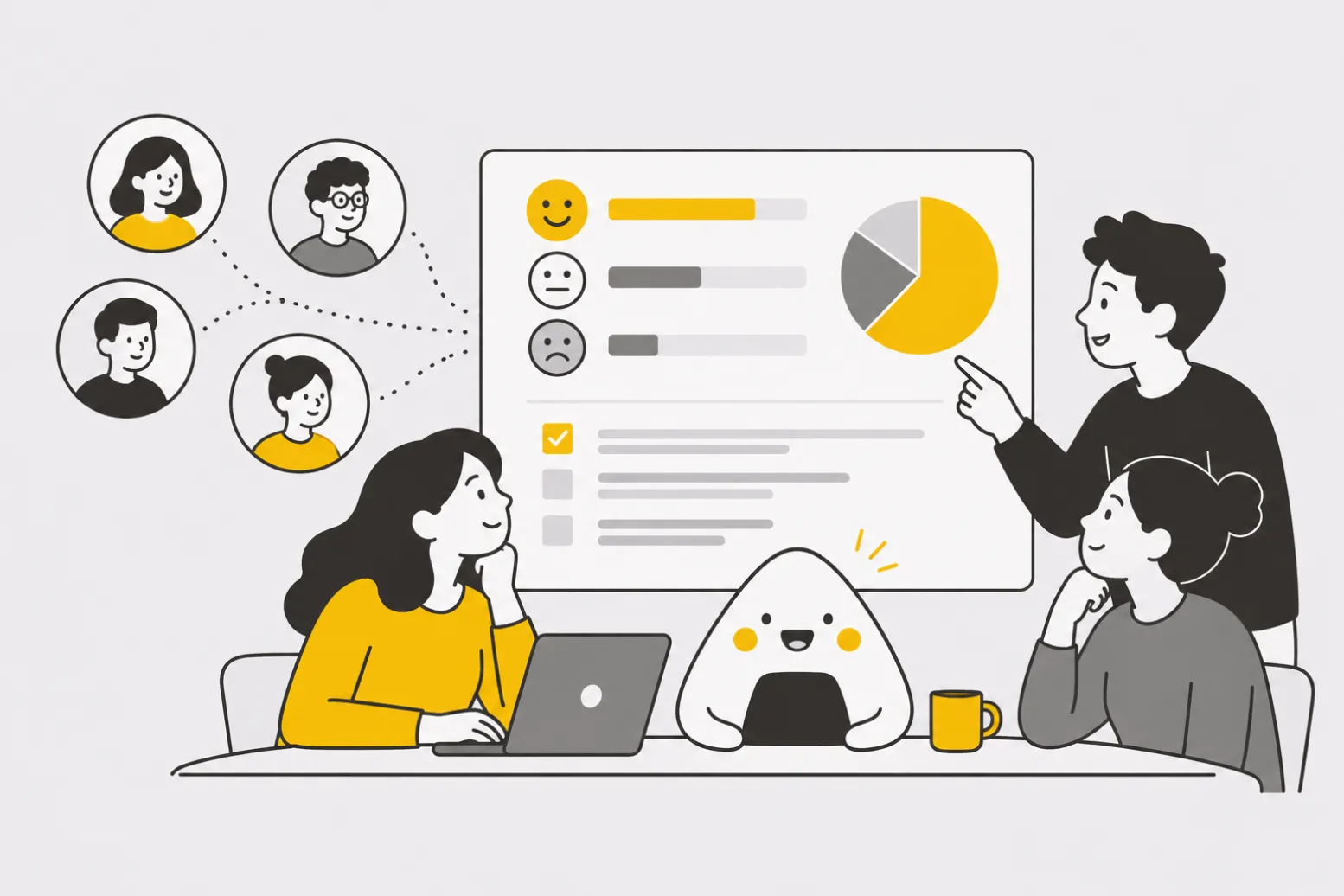
Table of Contents
Audio
A convenience survey is a survey sent to whoever is easiest to reach, rather than to a group chosen to represent your whole audience. It is built on convenience sampling, a non-probability method where availability decides who ends up in your data.
Product teams run these constantly, often without calling them that. A poll in the company Slack, a link in the newsletter, a quick form sent to the customers who already answer your emails: all of it counts. The results arrive in a day, they cost nothing, and they feel like evidence.
The catch is that the people who answer are rarely the people you need to hear from. Below you will find how a convenience survey works, where it quietly misleads you, and the situations where it is still the right call.
Convenience Sampling: How a Convenience Survey Works
In a probability sample, every person in your target group has a known chance of being picked. In convenience sampling, nobody works that out. You take the respondents who are nearby, willing, and quick to answer.
Take a product manager preparing a roadmap review on Thursday who wants to know whether customers care about a new export feature. She posts a link in the customer community, emails the ten accounts she talks to weekly, and asks two colleagues to forward it. Forty-three people respond by Wednesday. That is a textbook convenience survey.
It is useful to know where this method sits among its relatives. A comparison of convenience and purposive sampling published in the American Journal of Theoretical and Applied Statistics describes convenience sampling as drawing from whoever is conveniently accessible, while purposive sampling deliberately picks people with characteristics that matter to the study. The authors note that the right choice depends on the nature of the research, and that both are non-probability methods, so neither gives you a guaranteed picture of the full population.
Here are the usual forms a convenience survey takes in product work:
- A link shared in a community, newsletter, or social channel
- An in-app prompt shown to whoever happens to be active that day
- A form sent to existing customers who already respond to your team
- A hallway or conference-booth conversation with whoever stops by
- A poll posted in a LinkedIn group or Slack workspace
What they share is that you control the question but not the audience. The people who respond have usually opted in because they are engaged, opinionated, or friendly to your team. That is the property to keep in mind for everything that follows.
None of this makes the method bad. It makes it a tool with a narrow job. The trouble starts when a convenience survey is asked to do the work of a representative one, such as sizing a market or settling a prioritization argument.
Disadvantages of Convenience Sampling for Product Decisions
The main weakness is that the sample may not look like your customer base, and you cannot tell how far off it is. There is no sampling frame to compare against, so the skew stays hidden. Your forty-three respondents might be your most loyal users, your angriest ones, or simply the ones with free time on a Wednesday.
The common biases show up in predictable ways:
- Volunteer bias. People who choose to answer tend to feel strongly, positively or negatively. Quiet, indifferent users, who are often the majority, stay silent.
- Undercoverage. Whole groups never see the link. If you recruit through your newsletter, you will not hear from customers who unsubscribed, which is exactly the group you should worry about.
- Friendly respondents. People who know your team answer more kindly, so scores drift upward in a way that flatters the product.
- Bogus respondents. In paid or open online panels, some answers come from people who click through without reading.
The last one is better documented than most teams realize. Pew Research Center found that online opt-in polls can produce misleading results, in part because a small share of bogus respondents tend to pick positive answer choices, which can inflate how common rare attitudes and behaviors look. If you survey a niche audience, such as admins of a specific tool, a few careless responses can distort the number you present to leadership.
I have seen this play out in planning meetings. A single "78% of respondents want feature X" slide lands on a table, and the room stops asking questions. Nobody asks who the 78% were, how many there were, or how they were reached. A number from a convenience survey carries the same visual authority as one from a rigorous study, and that is the real danger.
Three habits reduce the damage:
- Report the sample size and how people were recruited next to every result.
- Describe findings as "among respondents" rather than "customers want."
- Compare who answered against your known customer mix, such as plan, region, or company size, and flag the gaps.
If the gaps are large, treat the survey as a source of questions, not answers. The results can tell you what to investigate next. They cannot tell you how many people feel a certain way.
The Convenience Sample Method: When It Is Good Enough
Fast and cheap is a legitimate trade when the decision is small, reversible, or exploratory. Convenience sampling earns its place in a few situations.
Pilot testing. Before you send a survey to a large audience, test it on a handful of friendly people. You are checking whether questions are clear, not measuring opinions. A confusing question that five colleagues misread will confuse five hundred customers.
Early discovery. When you are still working out which problems exist, you want range, not representativeness. Talking to whoever is available can surface issues you had not considered. Our guide on customer discovery covers how to turn those early conversations into testable hypotheses.
Qualitative testing with small groups. Usability work leans on small, convenient samples all the time. The Nielsen Norman Group's analysis of why five users are enough to find most usability problems rests on watching a few people from one user group repeatedly and fixing what you see. That works because the goal is finding problems, not estimating percentages. The same logic does not carry over to a survey that reports how many customers want something.
Tight budgets and short deadlines. Sometimes the choice is a convenience survey or nothing. A rough signal with honest caveats beats a guess, as long as nobody pretends it is more than that.
A simple test helps you decide. Ask what happens if the result is wrong. If the answer is "we adjust a label next sprint," a convenience survey is fine. If the answer is "we commit a quarter of engineering to the wrong feature," you need a better sample, or at least a second method to check it. Pairing a quick survey with interviews, product analytics, or a randomly drawn follow-up gives you two imperfect views that can confirm each other. Our walkthrough of the product discovery process shows how to combine them.
When you do use a convenience survey, write up its limits in the same document as the results. One sentence on who answered, how they were reached, and what the data cannot say will protect you later, when someone quotes the number without the context.
FAQ

Interested in working with us?
Our Interim/Fractional Product Managers, Owners, and Leaders quickly fill gaps, scale your team, or lead key initiatives during transitions. We onboard swiftly, align teams, and deliver results.
Read More Posts
October 19, 2026
Usability Testing: Methods, Types, Tools and Examples
Usability testing shows where real users get stuck. Learn the main types and methods, which tools to use, and how to run a first test this week.
October 20, 2026
Some CPOs are more CPOs than others
Influence can take a product leader part of the way. How far they get depends on the mandate behind them, and that gets settled before day one.
January 28, 2026
Mastering Product Prioritization with the RICE Score
Master the RICE score framework to prioritize your product roadmap with data. Learn how to calculate reach, impact, confidence, and effort to align stakeholders and maximize ROI.