

The Accelerated Build Trap: What Happens When We Substitute Speed for Strategy
Learn how to build sustainable product organizations by looking closely at the side effects of acceleration.


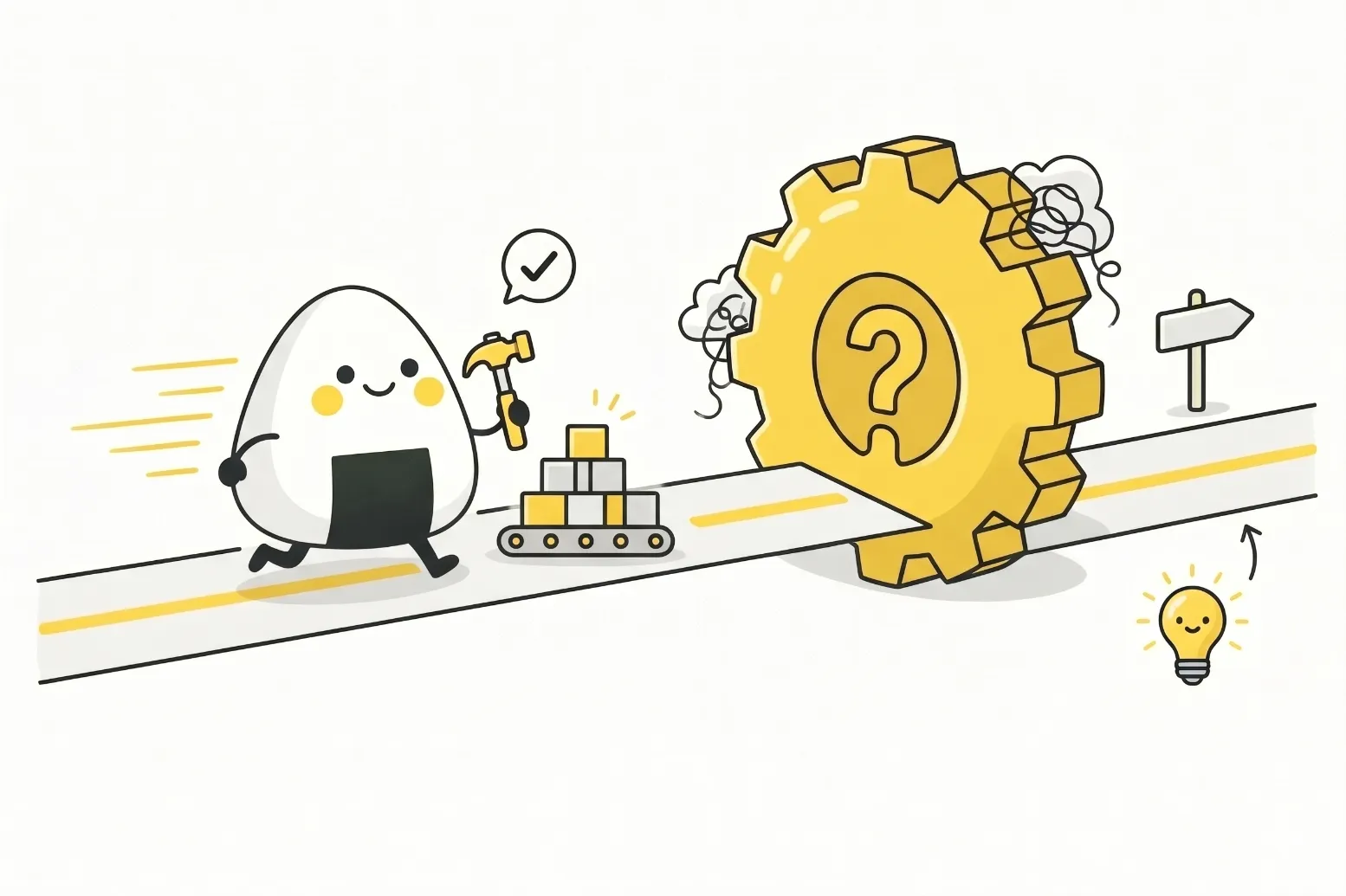
Table of Contents
We’ve spent the last few weeks at Product People facilitating an intensive, qualitative AI study, sitting down with 20 senior product leaders across Europe: CPOs, VPs, and Directors of Product who are managing real teams and substantial portfolios. The goal was simple: look past the marketing noise and map out exactly how generative technology is landing on the ground. We will be publishing the full report very soon so the community can dive into the broader data, but reviewing the early synthesis sparked a lot of practical thinking about where our discipline is actually heading.
Staring at these conversations didn't just give us data points; it highlighted a few core operational shifts that we need to talk about openly. This piece isn’t a dry executive summary of the report. Instead, these are our immediate, realistic takeaways: the specific trends and anomalies that stood out as the most meaningful challenges for product leaders today.
When you strip away the tech-conference hype, a very grounded reality check emerges. Many organizations are rushing to automate product execution before fixing their inputs, and in doing so, they are inadvertently supercharging the classic "build trap." Because the tools make execution so effortless, teams are now at risk of shipping polished feature bloat at record speed, without doing the hard work of validation first.
If we want to build sustainable product organizations, we need to look closely at the side effects of this sudden acceleration.
The "Microsoft Word" Fallacy and the Junior PM Gap
One of the most clear-cut observations from our study is the sheer amount of corporate anxiety surrounding "AI upskilling" and specialized "AI Product Manager" roles. Let’s look at this pragmatically: the anxiety is largely misplaced.
Listing proficiency in specific generative AI platforms on a product CV today is rapidly becoming the modern equivalent of boasting that you are "proficient in Microsoft Word." The interfaces are deliberately intuitive. If you give a competent product professional a week of hands-on, focused time, they can easily master the mechanics of how to prompt and utilize these systems. Knowing how to interface with an LLM is a baseline operational commodity; it is not the differentiator between a great product manager and a mediocre one.
The real risk isn't that teams won't learn the tools. It’s that they might use them to outsource the actual thinking and contextual judgment.
When a team delegates deep critical thinking to an automated model, they risk disconnecting from the actual user problem space. This points to a systemic organizational challenge that emerged clearly in our interviews: we are inadvertently pulling the ladder up from the next generation of product talent.
[Traditional Lifecycle] ──> Junior PM cuts teeth on Jira/PRDs ──> Learns context ──> Develops judgment
[Automated Lifecycle] ──> AI generates Jira/PRDs instantly ──> Junior roles cut ──> Talent Shortage
Think about how product leaders are traditionally developed. Junior PMs build their commercial instincts and product sense by grinding through foundational execution tasks: writing user stories, managing Jira tickets, and refining PRDs. Today, an LLM can generate those artifacts in a matter of seconds. Consequently, some organizations are tempted to reduce junior headcount, assuming they only need a lean team of senior operators to guide the software.
But this creates a long-term talent gap. If we eliminate the entry-level positions where foundational context and project mechanics are learned, we lose the training ground for the next generation of leaders. By optimizing for short-term headcount efficiency today, companies may be creating a genuine talent shortage five years down the line.
The Invisible Journey and a $7.5 Million Reality Check
AI systems excel at optimizing explicit, structured data points within a closed digital environment. If a conversion funnel experiences a 14% drop on a checkout screen, an analytical model can track and log that drop instantly. What it cannot do is understand why it happened in the messy, offline, and completely subjective reality of a human being's daily life.
AI lacks sensory and real-world context. It cannot experience a product firsthand, nor can it comprehend the emotional stakes a user feels when a broken workflow ruins their day or impacts their business.
Reviewing this insight in our study data immediately brought me back to a pivotal moment in my own career working with automated retail hardware. We had a sophisticated data network tracking user interactions across thousands of physical kiosks. The quantitative data showed a sharp drop-off in a highly valuable user segment at a critical step in the transaction. The numbers suggested that these users were simply unqualified and were being rightfully rejected by the system logic. If we had tossed an AI auditor at that dataset, it would have comfortably built a narrative confirming that everything was working exactly as intended.
But looking at the numbers from a human perspective, the conclusion felt off. We halted the dashboard analysis, gathered a cross-functional team, and conducted direct site visits across 20 different locations to watch real people interact with the machines in the wild.
What we discovered was entirely invisible to our digital dashboards. Under a highly specific, real-world environmental condition that occurred far more frequently than anyone realized, the physical hardware was malfunctioning and triggering a system rejection for users who should have passed through smoothly. By stepping away from the screen, applying human discovery, and experiencing the physical context, we isolated the error. That single, physically verified intervention recovered between $7.5 million and $10 million in annual recurring revenue, value that an analytical model would have permanently written off as "user error."
This is the stark difference between the visible digital funnel and what we call the invisible journey. The invisible journey is everything a human has to endure outside of your digital interface just to complete the core activity your product is built for. If a customer is trying to complete an online tax filing, the visible journey is the document upload screen; the invisible journey includes the fact that a crucial financial statement is delayed in the mail, or that the user is currently looking for a misplaced document.
AI can optimize the UI layout, but it remains blind to the human friction happening away from the screen.
The Sentiment Trap: Why LLMs Only Hear the Loudest 5%
To address this lack of context, another major industry trend has emerged: using LLMs to completely automate customer insight gathering. Companies are deploying models to scrape thousands of support tickets, sales transcripts, and online reviews, automatically tagging sentiment to generate quantitative "frustration scores."
We aren't trying to reinvent the wheel here, but let’s be realistic: this is a flawed approach. To understand why, we have to look at the psychological reality of why humans actually provide feedback. Users generally break down into three distinct categories:
- The Passionate Advocates: The rare superfans who truly love a product. You see them heavily in entertainment or hyper-focused communities (the users who will defend Slack to the death while downplaying the enterprise value of Microsoft Teams). They are vocal, but highly biased.
- The Overt Negatives: The frustrated users who have been inconvenienced by an operational bug or an edge case. They leave one-star reviews and contact customer support. They represent immediate operational noise, but their complaints are often reflections of isolated incidents.
- The Incentivized Reviewers: Those who leave feedback purely to gain a reward, promo, or credit, making their data transactional rather than experiential.
If you let an LLM process your customer feedback channels, it is exclusively synthesizing the data generated by the extreme, highly biased margins of your user base: the loud minority. The system treats this data as the absolute truth of your product's market health.
If you blindly build your roadmap based on what an AI synthesizes from these channels, you risk spending your engineering capital fixing loud, minor annoyances or over-indexing on biased feature requests. Meanwhile, you remain completely oblivious to the Silent Majority.
The vast majority of your active user base is entirely dispassionate. They use your product quietly every single day to get a job done. If they hit a minor friction point, they don't file a ticket or post a complaint; they just work around it. And when a more convenient alternative appears, they don't complain—they just quietly switch. These are the users who hold the real truth of your product's long-term viability.
AI cannot surface their insights because they aren't generating the explicit data points the model needs to feed on. You can only reach them through unautomated, human observation and direct conversations.
The Strategic Path Forward: Valuation over Velocity
When content production and software execution become incredibly cheap, the premium shifts entirely to orchestration, evaluation, and raw accountability. Turning a volatile, non-deterministic technology into a reliable enterprise product requires us to manage what we call the "AI tax": the organizational cost of monitoring, auditing, and correcting systems that fail in unique and highly plausible ways.
As we prepare to share the full results of our product leadership study, our challenge to the community is to stop using these tools as a shield against doing real, messy discovery. To protect your organization from the accelerated build trap, leadership should focus on three foundational principles:
- Enforce Continuous Dogfooding: Product managers need to stop relying entirely on analytical dashboards. They need to live, breathe, and QA test their own products on a regular basis. If your team isn't experiencing the practical frustration of navigating their own workflows, they don't fully understand the product they are shipping.
- Observe the Silent Majority: We must actively design operational frameworks that force product teams out of the office and into the room with dispassionate users. Give them the space to show you the reality of how your software actually fits into their daily lives.
- Measure Outcomes, Not Tickets: Evaluate your product teams based on business value recovered and friction minimized, not on the sheer volume of features shipped. AI can generate a hundred clean user stories a minute, but defining the precise problem space, managing the tradeoffs, and taking ultimate accountability when a system fails is work that cannot be distilled into an automated ticket.
Let’s step back from the hype, maintain our critical thinking, and remember that great products are built by humans, for humans, through real, un-filterable human context.

Interested in working with us?
Our Interim/Fractional Product Managers, Owners, and Leaders quickly fill gaps, scale your team, or lead key initiatives during transitions. We onboard swiftly, align teams, and deliver results.
Read More Posts
October 7, 2026
Monetized Products: What It Means and How to Plan Yours
A monetized product earns revenue from the value it delivers. Learn how to build a monetization strategy for software and apps, and which model fits.
October 5, 2026
Value Proposition: What It Is and How to Write One That Sells
A value proposition tells a specific customer why your product beats their current option. Learn the meaning, canvas examples, and how to test yours.
October 1, 2026
How to Map and Manage Stakeholders with Mendelow's Matrix
Mendelow's matrix sorts stakeholders by power and interest. Learn the four quadrants, see a worked product example, and avoid the common mapping mistakes.